Crusader and the star-studded 1926 Cincinnati Derby
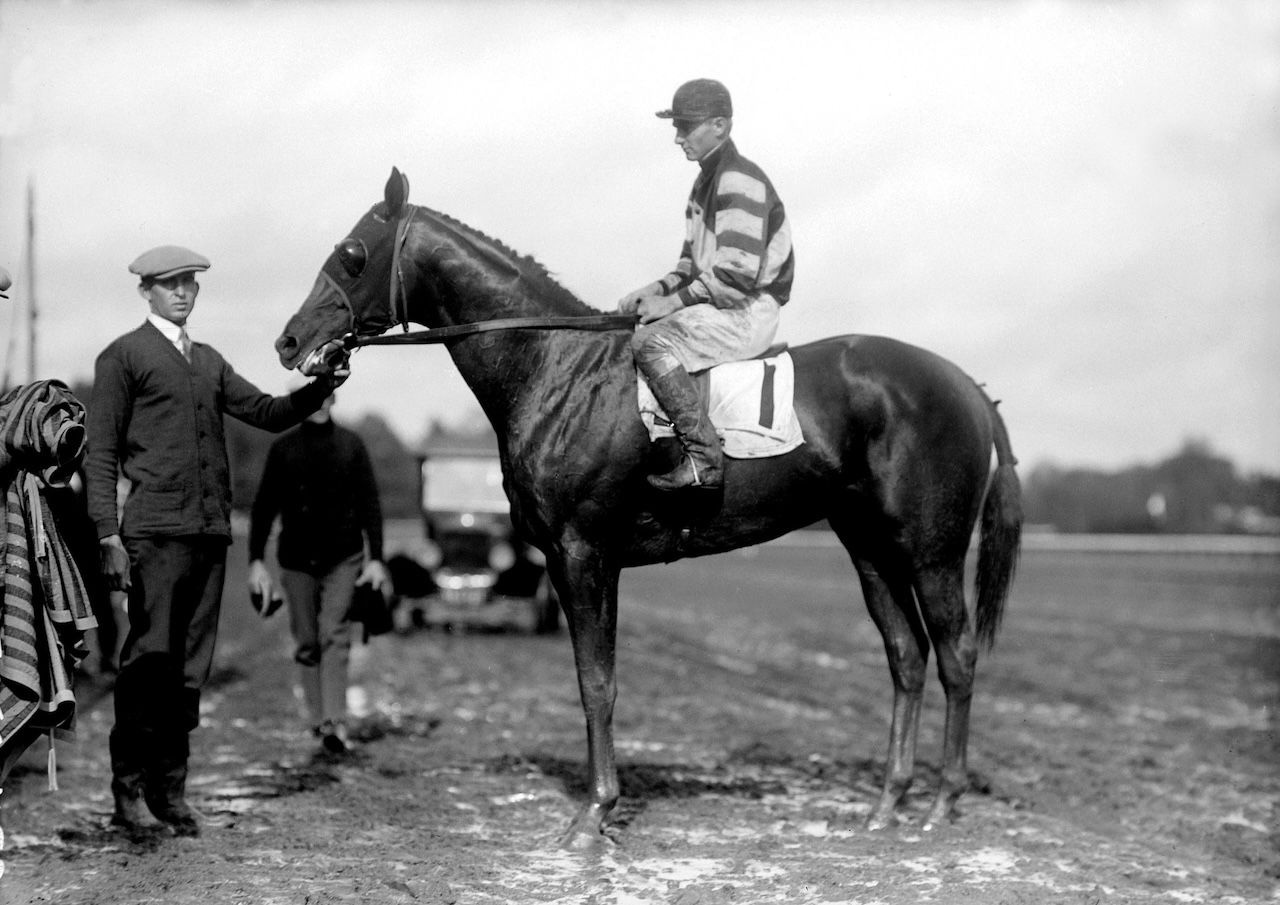
Earl Sande on Crusader. (Photo by the Keeneland Collection / Credit to the Cook Collection)

Belterra Park in Cincinnati, formerly River Downs, was once a breeding ground for prominent Kentucky Derby (G1) performers. Its signature event, the Cradle S. for two-year-olds, was won by Coax Me Chad, who later finished second to Swale in the 1984 Derby, and Spend a Buck, who in 1985 won the third-fastest Derby up to that point en route to Horse of the Year honors.
The Cradle was won in its later years by the Ohio-bred Harlan's Holiday (2001) and Bellamy Road (2004), both of whom wound up favored in the Kentucky Derby. Before them, Cradle runner-up Tejano Run occupied the same slot in the 1995 Churchill Downs classic.
Long before the advent of the Cradle, in the early years of its history, River Downs got more of a taste for quality older runners. Hall of Fame filly Princess Doreen won three stakes at River (then known as Coney Island) in the summer of 1925, while the legendary Seabiscuit placed twice in stakes company there in 1936, one year before claiming his first champion older male title.
But the most meaningful race in track history by far was for three-year-olds: the 1926 Cincinnati Derby, the centennial anniversary of which is July 24. Not only did it attract two of the season's three classic winners but also produced a track record still untouched a century later.
Grossing more than $28,000 (approximately $523,000 today), the Cincinnati Derby attracted a field of eight. But the crowd of 35,000 was firmly behind Crusader, who not only sported famous silks and an elite pedigree but was on a roll upon his arrival into the Queen City.
From the second crop of Man o' War, Crusader was owned and bred by Samuel D. Riddle, who had also campaigned "Big Red." If not able to entirely duplicate his sire's record on the track, Crusader at least was judged to have more closely resembled his formidable father than any of Man o' War's accomplished offspring.
That Crusader would go on to be something special appeared to be a longshot at the end of his juvenile campaign. Although he had won five of 11 starts and was a stakes winner at Laurel, he had lost two other stakes attempts, including the rich Pimlico Futurity after a rough trip.
As was the case six years earlier with Man o' War, Riddle never seriously considered pointing Crusader for the Kentucky Derby. One wonders, though, how well he might have run considering how much better Crusader got once he began consistently competing in two-turn races.
After a couple of second-place finishes to start 1926, Crusader was thrown into the Suburban H. against older horses over 1 1/4 miles. Carrying a feathery 104 pounds, Crusader was the entrymate of American Flag, another son of Man o' War widely judged the leading three-year-old of the previous year. Getting 20 pounds from American Flag, Crusader won in a gallop by five lengths.
One week later, Crusader was sent off as the odds-on choice in the Belmont S. over 1 1/2 miles. Contested in the slop, Crusader won by a length from Espino, who would be favored in their rematch in the Dwyer S. three weeks later.
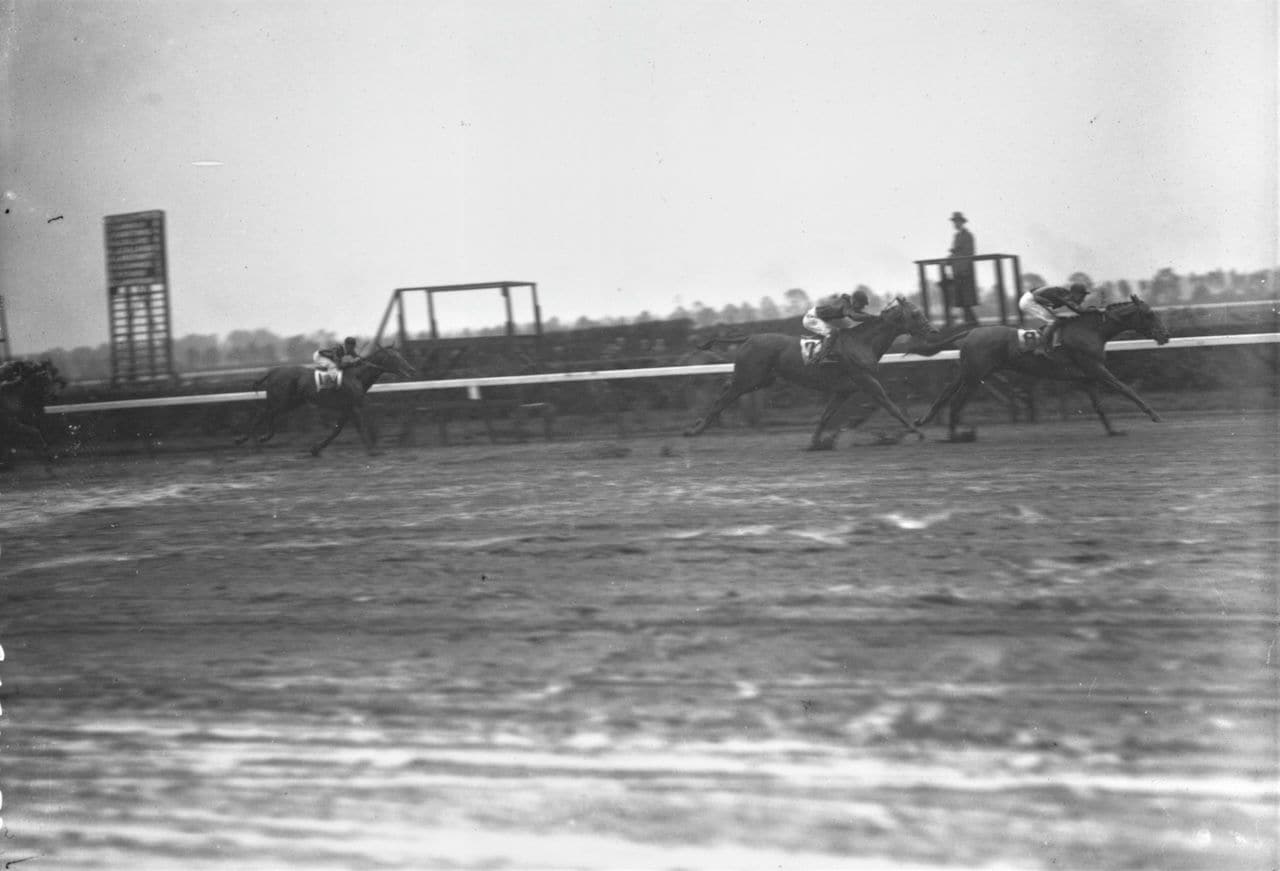
Crusader, A. Johnson up, running the Belmont Stakes. (Photo by the Keeneland Library / Credit to the Cook Collection)
Why was Espino favored over Crusader in the Dwyer? Separated by only a length at equal weights in the Belmont, bettors perhaps felt Espino could turn the tables in the Dwyer, the conditions of which required Crusader to carry 15 pounds more than Espino. Although Crusader easily handled Espino, Crusader had to work hard to win his third consecutive stakes by a nose over Chance Play.
Three weeks after the Dwyer, Crusader was sent off the 4-5 favorite for the 1 1/4-mile Cincinnati Derby. Second choice in the wagering was Carlaris, who had won two rich stakes earlier in the season at Tijuana, Mexico, albeit against questionable opposition aside from Princess Doreen. A distant third choice in the betting was Boot to Boot, winner of the Ohio State Derby with second-place finishes in the Blue Grass S. and Louisiana Derby to his credit.
Strongly ignored in the wagering at 22-1 was Display, a true "iron horse" amid a 19-start campaign. Although an infrequent winner, Display had at least claimed victory in the Preakness S., the most monetarily lucrative of the three classics that season. (The unsound Bubbling Over never raced again after easily winning the Kentucky Derby).
With Earl Sande up, Crusader looked a winner of the Cincinnati Derby a long way out while employing stalk-and-pounce tactics. Overtaking Carlaris approaching the stretch, Crusader kicked clear upon making the lead and won as he pleased by three lengths. Display rallied for second over Boot to Boot, with Carlaris a tiring fourth.
"I never had any doubt of the outcome of the race at any time during its running. I always had an armful of the horse, and it seemed to me as if I was on this daddy," said Sande, who had the privilege of riding Man o' War once. "He ran so steadily and strongly all the way, I could have gone to Carlaris at any time and felt that Crusader was always his master."
Crusader won the Cincinnati Derby in a track record time of 2:02. Given the paucity of classy 1 1/4-mile races in the intervening century, no horse at either River Downs or the reconverted Belterra oval has run the distance faster.
Crusader saw his win streak snapped after a slow start in the Travers S., but afterward finished out 1926 winning four of his remaining six starts, including the two-mile Jockey Club Gold Cup. Although no official championships would be awarded for another decade, Crusader is judged by historians the best American Thoroughbred of 1926.
Aside from a successful title defense in the 1927 Suburban, Crusader had few notable wins in his final two seasons of racing. His stallion record wasn't much better, as he sired only six modest stakes winners before dying at age 17 in 1940. Crusader was inducted into the Racing Hall of Fame in 1995.
Belterra and its predecessor have seen only a smattering of elite racehorses in its long history, but Crusader was undeniably one of them.
ADVERTISEMENT