Japan's ascent in international horse racing: World rankings tell the tale
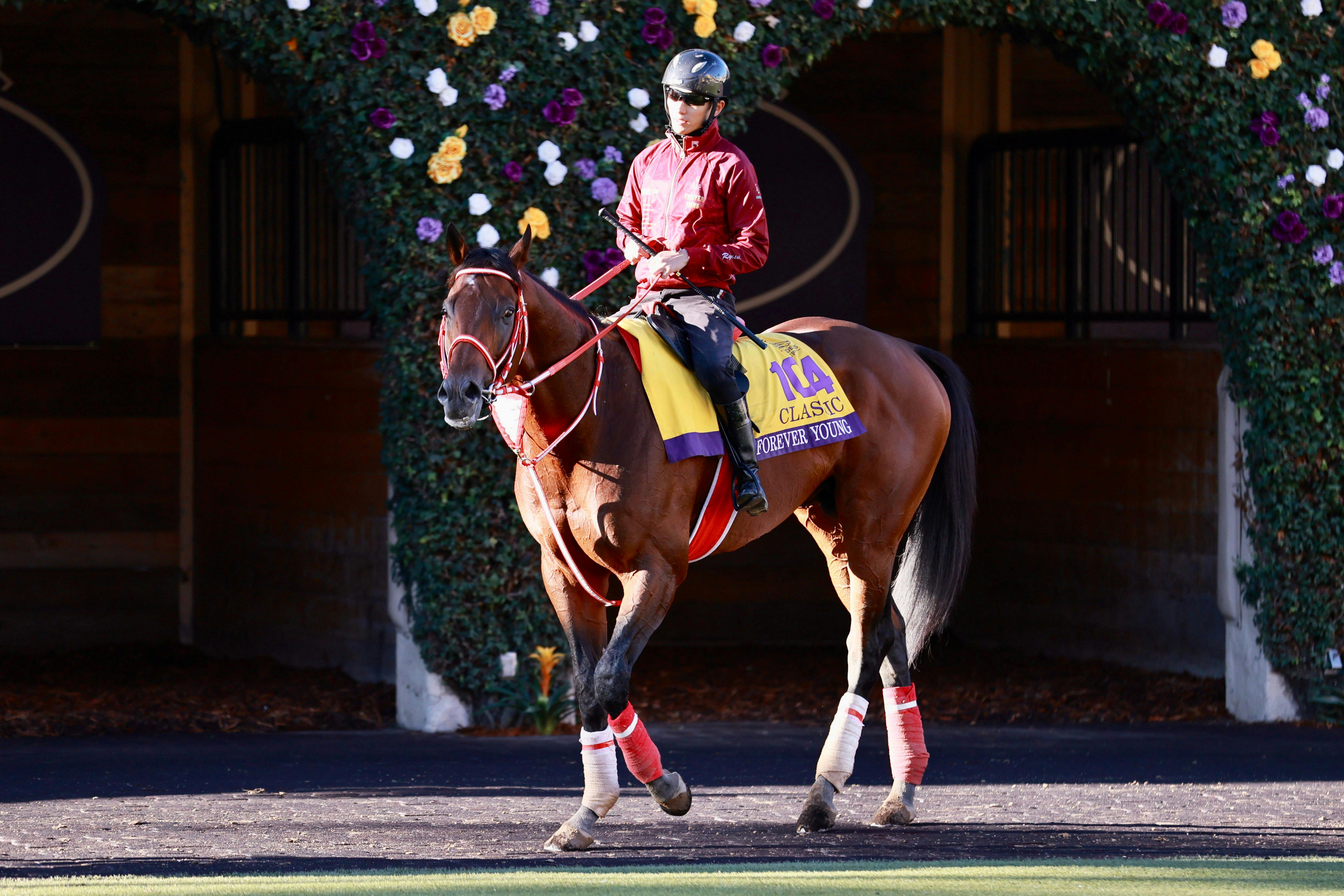
Forever Young in the Breeders' Cup Classic. (Photo by horsephotos.com)

February 27th, 2026
Japan has dispatched a series of outstanding Thoroughbred ambassadors on the world stage in recent years, becoming a force in international racing festivals.
Japan’s rise to prominence is reflected in the Longines World’s Best Racehorse Rankings (WBRR), horse racing’s version of the official rankings in sports like golf, tennis, and soccer. Twice over the past decade or so, Japanese turf performers topped the charts – Just a Way and Epiphaneia made it a one-two for Japan in the 2014 standings, and Equinox was the clear world champion in 2023.
While Japanese horses reached world-class status on turf first, their dirt game has improved markedly. Forever Young exemplifies this development, from his near-miss third in the 2024 Kentucky Derby (G1) to his victory in the 2025 Breeders’ Cup Classic (G1) and back-to-back triumphs in the world’s richest race, the $20 million Saudi Cup (G1).
Yet the rise of Japan goes beyond its flashy headliners. A deeper dive into the WBRR over the past 15 years reveals the increasing strength in depth of Japanese bloodstock.
In 2011, a total of 27 Japanese-bred horses achieved high enough ratings to be listed in the year’s final WBRR standings. Two of them ran to a lofty mark in different races, thereby appearing twice. The top Japanese horse was tied for 17th overall, and a handful of horses made the cut in dirt races.
Fast forward to 2025, and 50 individual Japanese-bred horses earned their way onto the year’s final WBRR. Nine of them made multiple appearances on the list. Japan’s highest-ranked performers, Forever Young and turf star Masquerade Ball, were in a tie for second overall. And 11 dirt horses met the qualifying standard.
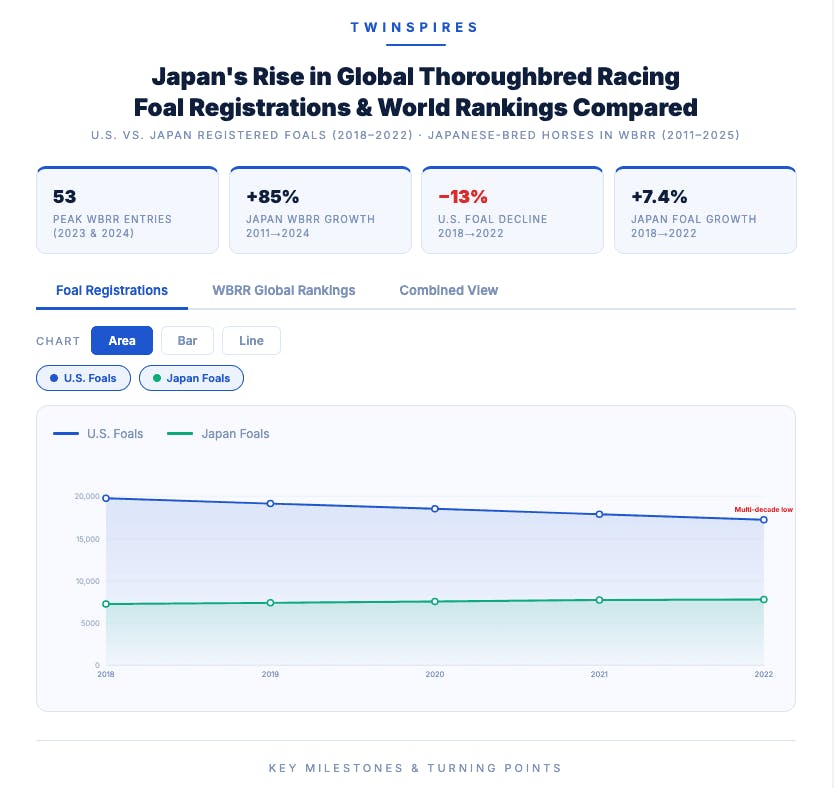
To put these metrics into proper perspective, compare the annual foal crops in Japan and the United States. The U.S. produces more than twice the number of foals. Even so, the 2025 WBRR features a total of 50 U.S.-breds – the exact same as Japan, which is producing high quality from a smaller pool of foals.
The governing structure of the Japanese racing industry assists the drive for excellence. Established by law and supervised by the Ministry of Agriculture, Forestry, and Fisheries, the Japan Racing Association (JRA) is far more than a racetrack operator.
The JRA coordinates multifaceted efforts to improve the breed at every stage of a horse’s life cycle. Its initiatives include the Equine Research Institute, training farms and centers to implement scientifically based practices, and the Horseracing School to educate aspiring jockeys and stable staff.
Without the right bloodlines to furnish the raw materials, though, the support structure can only go so far. That’s where the Yoshida family comes in, to such a degree that the modern Japanese Thoroughbred wouldn’t exist without them.
The late Zenya Yoshida’s acquisition of Sunday Silence as a stallion is widely hailed as the game changer. The 1989 Kentucky Derby and Breeders’ Cup Classic champion, Hall of Famer Sunday Silence, became a supersire who redrew the genetic map of the Japanese racehorse.
But the Yoshida family’s contributions extend further, to the importation of other stallions and mares who turned out to be essential building blocks for the future. Zenya’s sons have played pivotal roles in this regard.
Katsumi Yoshida’s Northern Farm, the perennial leading breeder in Japan, and Teruya Yoshida’s Shadai Farm have a history of collecting marquee mares from abroad. Their brother Haruya Yoshida’s Oiwake Farm might not be a household name, but it has likewise had success with imported mares that stood the test of time.
Northern Farm’s most celebrated matron, Irish-bred Wind in Her Hair, produced the legendary Deep Impact. Sunday Silence’s greatest son, Deep Impact, lived up to his name both on the racecourse and at stud.
Deep Impact’s full brother, Black Tide, was less accomplished on the track, but he left his own legacy through his champion son, Kitasan Black (the sire of Northern Farm-bred Equinox). Moreover, Wind in Her Hair’s influence endures through her daughters as well, with her female line continuing to churn out top performers.
Katsumi purchased Irish-bred Manfath while she was carrying future champion King Kamehameha. Representing a different male line from Sunday Silence, King Kamehameha proved to be a dynamic complement to his bloodlines. King Kamehameha founded his own sire line featuring such influential sons as Duramente, Rulership, and Lord Kanaloa.
Another Katsumi purchase, British-bred Kirov Premiere, foaled champion filly Cesario. The first Japanese-bred to win a U.S. Grade 1 in the 2005 American Oaks (G1) at old Hollywood Park, Cesario was even more important as a Northern Farm broodmare. She produced three major sons who are now sires – the aforementioned world number two Epiphaneia, along with champions Leontes and Saturnalia.
Forever Young embodies the pattern. Both Forever Young and his sire, Real Steel, are out of mares that Katsumi imported from the U.S. Real Steel, as a son of Deep Impact and Loves Only Me, is a full brother to 2021 Breeders’ Cup Filly & Mare Turf (G1) champion Loves Only You.
Sourcing the world’s elite bloodlines and cultivating them in a well-designed ecosystem, transformed Japan into a global racing powerhouse.