Top 10 storylines for 2026 Japan Cup
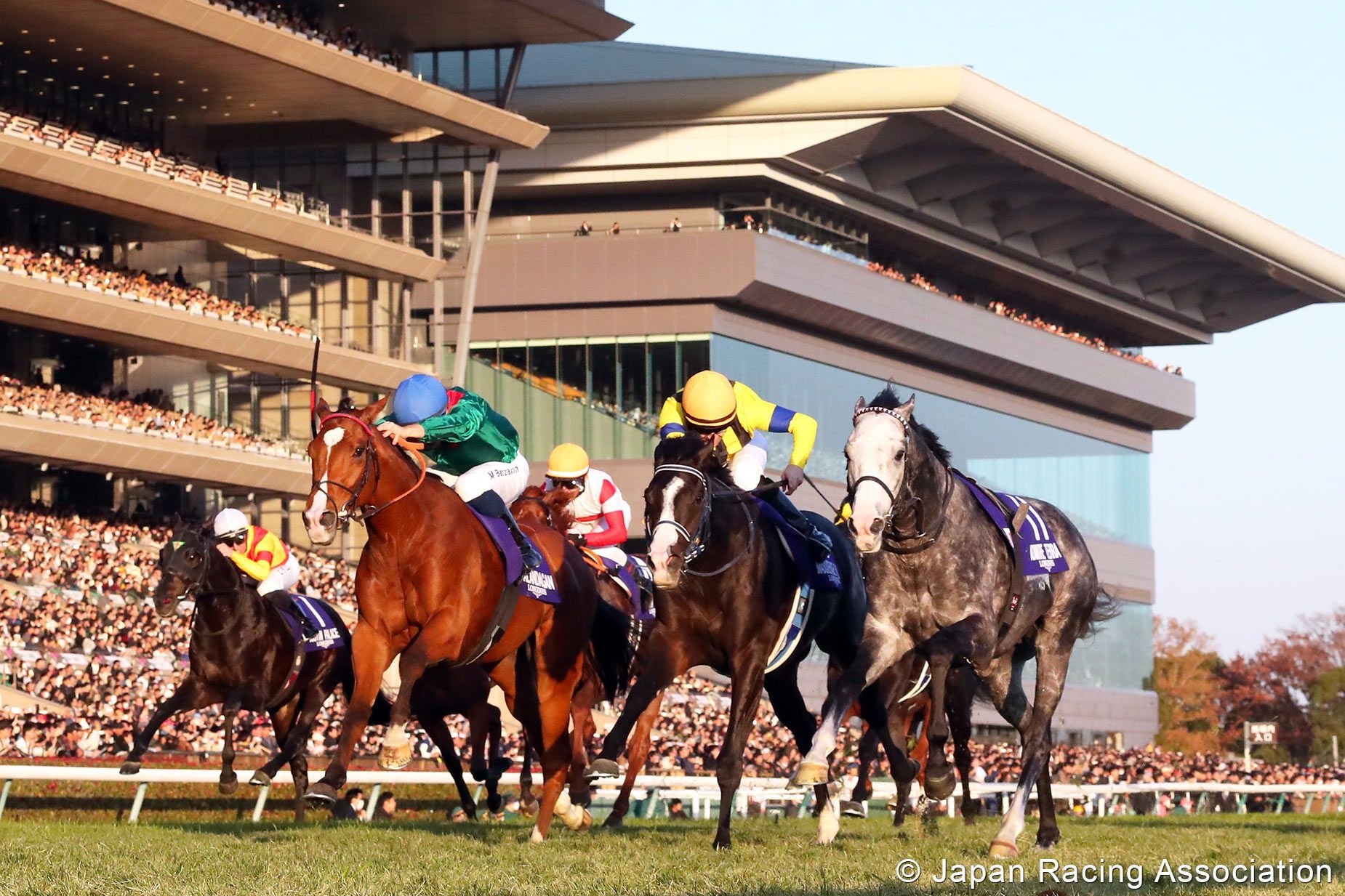
Calandagan (left) edges Masquerade Ball and the riderless Admire Terra in the Japan Cup (G1) (Copyright Japan Racing Association)

Six international hopes, led by defending champion Calandagan and newly-crowned European Horse of the Year Ombudsman, have descended upon Tokyo for the 46th Japan Cup (G1).
The home team includes the respective second through fourth from last year’s edition – Masquerade Ball, Danon Decile, and Croix du Nord – with varying cases to fare better this time around. My totally outside-the-box idea for a crazy longshot, well-bred Urban Chic, has loads of back class and could be on the way back after bleeding episodes marred his efforts over the winter.
There’s also a highlight on the undercard, as the Japan Road to the Kentucky Derby begins with the Cattleya S. Scheduled as the ninth race (11:50 p.m. ET Saturday night), the Cattleya features the exciting Winter Breeze and flashy debut winner Satono Hercules.
The Japan Cup, slated for 1:40 a.m. ET, anchors the 12-race program. Be sure to read my colleague Alastair Bull’s selections and wagering strategies for both Tokyo features.
Calandagan aims to rewrite the record book
By edging Masquerade Ball last year in a record time of 2:20.3, Calandagan proved that a European invader could still beat the Japanese on their home turf. A full 20 years had passed since the last successful raider, British-trained Alkaased in 2005, and an aura of invincibility had enveloped the locals.
If Calandagan can repeat, he would make history not only as the first international runner to win the Japan Cup twice. The French gelding would also be the first male to score two victories. Gentildonna (2012-13) remains the lone back-to-back winner so far, and another great Japanese distaffer, Almond Eye, collected her trophies in non-consecutive years (2018 and 2020).
Aside from the historical task confronting him, Calandagan doesn’t arrive in quite the same form as a year ago. Last November, the Aga Khan Studs homebred was riding a winning streak, and coming off a triumph over Ombudsman in the Champion (G1) at Ascot. This time, Calandagan enters after losing his title defenses in both the King George VI & Queen Elizabeth (G1) (to Kalpana) and the Champion, where Ombudsman turned the tables in grand style. Calandagan ran an honorable second on both occasions, but if the same pattern holds at Tokyo, he’ll succumb to the horse he beat last year, Masquerade Ball.
Ombudsman takes distance test in last hurrah
Ombudsman’s trademark is brilliant acceleration, as evidenced in his consecutive victories in the Prince of Wales’s (G1) at Royal Ascot and in the Champion over the same course and 1 1/4-mile distance. Therein lies the rub about his Japan Cup tilt – his first at the about 1 1/2-mile trip. It will also be his only attempt, since the Godolphin star is retiring to Kildangan Stud following this last hurrah.
Although Ombudsman won at about 1 5/16 miles in last year’s Juddmonte International (G1), that came on a flat track at York. Tokyo isn’t terribly tough, but there are a couple of inclines around the circuit, including at the top of the homestretch, and over the longer distance, might that take a bit of the edge off Ombudsman’s late kick?
The rebuttal is that Ascot is a stiff track, and Ombudsman has dazzled up the stretch, albeit at 1 1/4 miles. On the other hand, he’s looked consistently vulnerable over another stiff course, Sandown, where the longer straight could be exposing stamina limitations.
Ombudsman’s pedigree doesn’t give iron-clad reassurance, nor does the stride data available from his British races. As data maven Simon Rowlands has explained in the past on attheraces.com, true 1 1/2-mile performers tend to have a stride cadence that fits certain parameters.
Ombudsman’s minimum and maximum stride frequency are both higher than you’d typically see in a horse who stays 1 1/2 miles well. Looking at his stride data from Ascot, York, and Sandown on racingtv.com, he’s routinely recording a minimum stride frequency of 2.20 (or slightly more) strides per second and a maximum stride frequency of about 2.40 (occasionally reaching 2.50) strides per second. By contrast, 1 1/2-mile aficionados would generally inhabit the range of a 2.10 minimum/2.32 maximum.
This isn’t a prescriptive determination. Indeed, you can try to use similar data against the claims of Minnie Hauk and Goliath, both proven repeatedly at the highest level at this distance. Still, the stride data in combination with other factors – pedigree, his shakier performances at Sandown, and the fact that co-trainer John Gosden never tried to stretch him out before – all reinforce the qualm.
If Ombudsman is as devastating at this trip, he’ll give Godolphin a first Japan Cup in the royal blue silks. He would also provide a monetary windfall, thanks to the JRA’s lucrative bonus structure for winners of designated races.
Minnie Hauk goes to bat for record-chasing Aidan O’Brien
Aidan O’Brien tied his world record of 28 Group 1 wins in a single year when Benvenuto Cellini starred in the Breeders’ Cup Turf (G1), and Minnie Hauk will try to give him the magic number 29.
Last year’s dual classic winner and Prix de l’Arc de Triomphe (G1) near-misser hasn’t had a comparable campaign this season. But O’Brien revealed that Minnie Hauk was compromised by persistent foot problems, and he’s only just gotten her back to her physical best this fall.
Minnie Hauk rebounded in the British Champions Fillies & Mares (G1) in her latest at Ascot, and with a favorable set-up here, she’s eligible to put up a bolder show against Ombudsman and Calandagan than she did over the summer. Even so, the Frankel filly would need to raise her game again to threaten for the win.
Danon Decile back to best in key local stepping stone
Danon Decile was explosive in the Tenno Sho Autumn (G1), traditionally the key lead-up race over the course, to stamp himself as the top Japanese hope. He swept down the outside with a dazzling final 600-meter sectional in :32.9 as the favorites, Croix du Nord and Masquerade Ball, were mired on the inside.
The son of 2014 Japan Cup star Epiphaneia was ending a minor-award syndrome that dated back to last year’s Japan Cup, where he placed third. That had been his first start back since flopping behind Ombudsman in the 2025 Juddmonte International, and Danon Decile has every right to be sharper in their rematch on his home court.
Proven over course-and-distance as the 2024 Japanese Derby (G1) hero, Danon Decile also owns a victory over Calandagan in last year’s Dubai Sheema Classic (G1). The caveats are that he’d been beaten by Croix du Nord (my favorite) twice earlier this season, and he needs to keep his composure amid the excitement of a big-race atmosphere on Japan Cup Day.
Croix du Nord, Masquerade Ball much better than Tenno Sho results
The top two from the 2025 Japanese Derby, Croix du Nord and Masquerade Ball, underscored the strength of their crop when running well in defeat in last fall’s Japan Cup. Neither was able to perform up to that level in their recent rematch in the Tenno Sho Autumn, thanks to a traffic snarl in the stretch. Croix du Nord was a one-paced fifth once he saw daylight, while Masquerade Ball was arguably more compromised by his trip in 11th.
Croix du Nord rates a top threat if he’s regaining his peak form, and I still want to regard him as the captain of Team Japan. Remember that he beat Daryz in their French tune-up for the 2025 Arc, before it all went wrong for Croix du Nord in the main event.
A better-than-appears fourth in the 2025 Japan Cup, when trying to turn the page from his Arc flop, Croix du Nord came agonizingly close to an historic Grade 1 sweep in the first half of this season. He captured the Osaka Hai (G1), just lasted in the Tenno Sho Spring (G1) over two metric miles, and missed narrowly to Meisho Tabaru on unsuitably yielding ground in the Takarazuka Kinen (G1).
The son of 2016 Japan Cup champion Kitasan Black hasn’t exactly wowed trainer Takashi Saito in his recent works, but jockey Cristian Demuro was encouraged by the extra breeze that Croix du Nord squeezed in on Friday.
Masquerade Ball was making first start back since his King George VI & Queen Elizabeth debacle at Ascot. It’s a shame that he didn’t do himself justice there, since he’d missed by a whisker to Calandagan in last year’s Japan Cup as a three-year-old. Masquerade Ball was also a terrific second to Romantic Warrior in the QEII Cup (G1) in his belated 2026 debut at Sha Tin, where he might have gotten closer to an upset with different tactics or race shape.
In a recent interview with idolhorse.com, jockey Christophe Lemaire was adamant that he could feel Masquerade Ball was back in business in the Tenno Sho. The Duramente colt has been training in cheekpieces to help his focus, and it wouldn’t be a surprise if we see the real Masquerade Ball. If he can gain revenge on Calandagan, he’d lift Lemaire into a record-tying fifth Japan Cup win.
Others hoping to leverage the Tenno Sho Autumn/Japan Cup pipeline are fourth-placer Tagano Dude; sixth Shake Your Heart, the hero of the Sapporo Kinen (G2) two back who’s yet another late bloomer by the outstanding sire Heart’s Cry; and ninth Cosmo Kuranda, who figures to be part of the early pace.
Can the in-form Yutaka Take lift Meisho Tabaru?
The all-time leader with five wins, legendary jockey Yutaka Take has enjoyed a career year in 2026. The 57-year-old has won four top-level events, constantly updating the record for the oldest jockey to win a Grade 1 on the JRA circuit.
One of those came courtesy of Meisho Tabaru when he repeated in the Takarazuka Kinen, holding off Croix du Nord. The Arc didn’t pan out for Meisho Tabaru, and his distance queries remain. Yet his forward running style, in a race without a lot of speed on paper, ensures that he’ll be in contention early. It’s just a question if he can stay on at crunch time, but Take has been inspired of late.
Where are the three-year-olds?
Not a single member of the current classic generation is here. Those inclined to race on at the end of the season have looked at Hong Kong and the Arima Kinen (G1) rather than the Japan Cup.
While Triple Crown-seeking Lovcen understandably wasn’t going to wheel back after flaming out in the third jewel, the Kikuka Sho (G1), it would have been fascinating to see budding star filly Monroe Walk here. But given her profile as a late-developing type who cut it close in the final fillies’ classic, the Shuka Sho (G1), it’s probably prudent to give her more time.
Goliath returns with an eye on Arima Kinen
Sixth in the 2024 Japan Cup, Goliath now returns in the shadow of stablemate Calandagan. Yet he too could propel their trainer Francis-Henri Graffard into the record book as just the second international horseman to train two Japan Cup winners. The precedent was set by Sir Michael Stoute, who sent out Singspiel (1996) and Pilsudski (1997).
Graffard just made history last week when Erdenali became the first foreigner to win the Mile Championship (G1) at Kyoto, and he’s likely to pursue another milestone in the Arima Kinen. Graffard has mentioned that prestigious Nakayama feature as Goliath’s next objective, citing his belief that the gelding is better going right-handed.
Goliath has historically been a tricky customer who needs the race flow to suit him. But the German-bred can be spectacular when he’s in the zone, and he comes off a victory in the Preis von Europa (G1). With a better break at Tokyo than he got a couple of years ago, Goliath is capable of a better result.
Ethical Diamond relies on Pilsudski precedent
Pilsudski is the only one to turn the Breeders’ Cup Turf/Japan Cup double, accomplishing the feat in successive years (1996-97), and Ethical Diamond hopes to emulate him. But his lone point of commonality is attempting the Japan Cup the year after his stunning Turf upset at Del Mar.
Beyond the obvious contrasts with his background as a former hurdler, Ethical Diamond doesn’t brandish a comparable resume at present either. His 2026 campaign is a far cry from the relentless Group 1 pitch of Pildsudski’s, and his ninth in his Breeders’ Cup title defense at Keeneland doesn’t change the narrative.
Ethical Diamond’s trump card remains trainer Willie Mullins, who has won in Japan before (albeit in a jumps race ages ago). He also picks up Ryusei Sakai, best known as the rider of global dirt star Forever Young.
Teao flies the flag for Chile by way of California
If Chilean Horse of the Year Teao can win his first start in the Northern Hemisphere off a seven-month layoff, it would be a massive achievement for his home country and for his new trainer, John Sadler.
Top-class on both dirt and turf, the Haras Don Alberto homebred was last seen conquering the April 26 Gran Premio Latinoamericano (G1) that was held this year in Peru. Teao thereby earned an automatic berth in the Japan Cup. He shipped to Sadler with a view to acclimating to life north of the equator, but he wasn’t able to get in a U.S. prep race as initially planned.
Teao faces a stiff task, especially considering that he prevailed in a photo in his lone try at this trip, the El Derby (G1), implying that this might be beyond his optimum. Yet he’s been training well, and as a maternal grandson of Japanese dirt celebrity Seeking the Dia, he holds sentimental appeal for the local fans too.
A trailblazer for Chile just by lining up here, Teao reunites with jockey Luis Torres, who masterminded his victories in both the El Derby and the Latinoamericano.
Postscript: Keep longshot hope alive for Urban Chic?
Urban Chic doesn’t qualify as a storyline since he’s being totally overlooked, but the 2024 Kikuka Sho winner fits as a place chance on his best day.
In last year’s Tenno Sho Autumn, over a distance shorter than ideal, he rattled home in :32.2 to snare fifth in a blanket finish. He wasn’t beaten much by Masquerade Ball and Museum Mile (the next-out Arima Kinen winner), and off that evidence, Urban Chic had claims of factoring in the exotics back up in trip in the Japan Cup. Instead, he went to the Hong Kong Vase (G1) and disappointed when racing too keenly, but his 5-1 odds in a loaded field attest to his inherent quality.
Urban Chic reportedly bled again in his subsequent start at home in March and headed to the sidelines. Resurfacing in the Aug. 30 Niigata Kinen (G3) on a rain-affected course, he rallied bravely under joint top weight for fifth, edging another classy comebacker, Durezza.
I’m taking that as a positive sign that Urban Chic is ready to fire back in more congenial circumstances here. Trainer Ryo Takei has sounded enthusiastic about his workouts, and it could be significant that he picks up Alexis Pouchin.
As a son of 2019 Japan Cup winner Suave Richard (himself by Heart’s Cry), out of a mare by Harbinger, from the family of Deep Impact, Urban Chic is closely related to champion filly Regaleira. With their pedigrees, I’ve long had a soft spot for both.
ADVERTISEMENT