Need for Speed: What the Fastest Breeds Teach Us About Racehorse Evolution
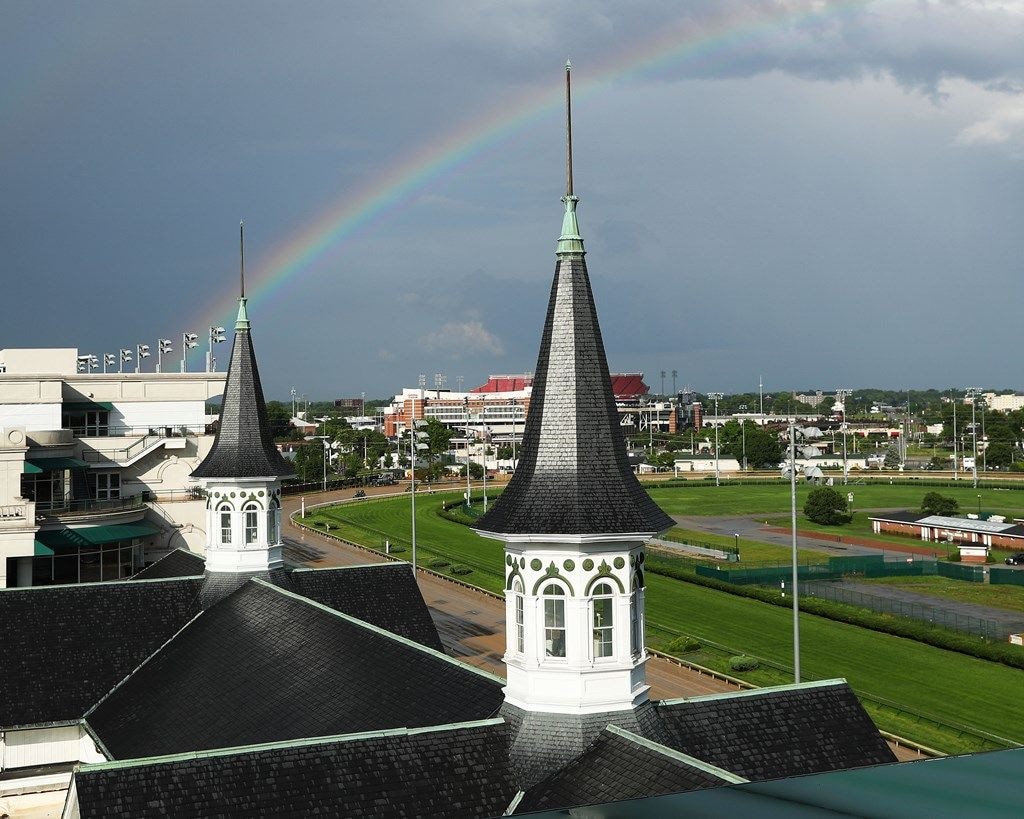
Churchill Downs scenic photo (Coady Media)

Updated:
When humans first domesticated the horse nearly 4,200 years ago, their first question may have been, ‘What do I need to ride this thing?’ and the second, ‘Could this one be faster than the others?’ From this, the idea of horse racing was born, a sport that predates beloved pursuits like baseball, soccer, and more. As racing matured from a casual match race between friends into a business spanning countries and continents, the science of speed and stamina followed, answering questions about how these innate equine talents work in these breeds that we all love to watch.
My How They Fly!
By necessity, horses are built for speed. In the wild, horses are prey animals, subject to pursuit by predators like bears and wolves, so escape is essential to their survival, as is safety in numbers and their keen senses of sight and hearing. Their long legs, musculature, and light bone structure make them efficient runners, and their cardiovascular system is designed to efficiently distribute oxygen to their muscles. Since their domestication, they have also become partners with humans in everything from transportation to labor to sport, their natural attributes developed for those various purposes through breeding, which has created over 600 different breeds in five categories.
Included in that long list are those that wow us with how they zip over the ground at speeds of 40 miles per hour (mph) and higher. The quarter horse, a breed whose origins date back to the American colonial era, tops the list at 55 miles per hour. In America’s earliest days, cleared land was at a premium, so any racing had to happen over shorter distances, like a quarter of a mile. To create horses suited for shorter distances, breeders paired Thoroughbreds imported from England with the descendants of Spanish Barb horses that Native Americans developed into a stock horse that suited their many needs. Though the colonies soon expanded and more traditional racecourses appeared, the Quarter Horse remained a favorite for those expanding the country westward, and thus the breed’s place was sealed.
Also among the fastest breeds are the Arabian, from whom the Thoroughbred descends via the Godolphin Arabian, the Byerley Turk, and the Darley Arabian, imported to England in the 17th century. The Arabian breed has been around for more than 3,000 years, tracing its origins to the Middle East, where Bedouin tribes cultivated their horses for their endurance and ability to thrive in desert environs. Because of its speed and versatility, topping out at 40 mph, the Arabian not only has its own series of races worldwide, but also shows up in the DNA of other breeds, speaking to its history as the chosen partner for both soldiers and traders. Though the breed is speedy, it is most noted for its stamina, which made the Arabian an ideal genetic partner for native English mares. Thus, the Thoroughbred was born.
Not to be outdone by its flat racing kin, the Standardbred also can get rather quick on the track, even with the added weight of driver and two-wheeled sulky (or bike). Standardbreds are an agglomeration of several breeds, including the Thoroughbred, thanks to foundational sire Messenger; the Norfolk Trotter, which gave us Hambletonian 10, from whom most of the breed descend; and Morgans, a light horse breed known for its trot. This breed tops out at 30 mph, which might seem slow alongside Quarter Horses and Arabians, but they achieve those speeds at gaits like the trot and the pace, which are two-beat gaits where legs move in pairs, unlike the gallop, a four-beat gait.
Of all of these speedy breeds, the best known is the Thoroughbred, created from the pairing of Arabian sires with English and Irish native stock. Early records of Thoroughbred breeding emphasize the sire over the dam, leaving questions as to the exact breed of these foundational mares. A 2010 study by Bower, Campana, et. al., showed that the estimated 74 original dams “were not exclusively Arab or Oriental. Rather, Thoroughbred mares were of cosmopolitan European origin, with contribution from Barbs and with British and Irish Native horses playing a greater part in the founding of the Thoroughbred breed than previously recognized.”
That genetic combination proved potent enough that the Thoroughbred soon became the most valued breed of racehorse for the English aristocracy, who then imported their preferences about the sport and the horse to America. While the breed tops out at an average of 35-40 mph, the mare Drip Brew recorded the fastest quarter of a mile ever in a 2020 race at Prairie Meadows, traversing two furlongs in :19.93, achieving a top speed of 45 mph in the process. However, sustaining that kind of speed over longer distances, as races tend to be anywhere from 5.5 furlongs to 2.5 miles, is tougher. The world record for a mile of 1:32 1/5, set by Dr. Fager in the 1968 Washington Park Handicap at Arlington Park and equaled by Najran in 2003, puts his speed at 39 mph, while the record for 1 1/4 miles, considered a classic distance, is Spectacular Bid’s 1:57 4/5 from the 1980 Charles H. Strub stakes at Santa Anita, his speed maxing out at 38 mph.
But what physiological characteristics allow Thoroughbreds to be such speed machines over these kinds of distances? The answer lies deep within their cells, where genes, the building blocks of both man and horse, create the magic.
How Do They Go?
To share the scientific research on speed and stamina in the horse and more specifically, the Thoroughbred, would take more words than this article can share, but let’s explore some of what centuries of breeding and investigation have told us so far.
We know that both nature and nurture play a role in maximizing a horse’s performance. Diet and exercise, the nurture side of the equation, play a role in preparing a racehorse for their job, ensuring that they not only have the right fuel but also the right preparation for the task ahead. While years of experience can help build practices that work, they cannot substitute for the physical attributes that every athlete requires to perform. Horses have evolved to be faster and run farther than humans by necessity and science has isolated the origins of those talents.
The faster breeds of horses, like Thoroughbreds, are characterized by their fast-twitch musculature, which allows them to perform at high intensity for short periods, and their efficient respiratory and cardiovascular systems, which support that type of activity. The protein myostatin, produced by the MSTN gene, is one of a group of proteins that help control the growth and development of tissues throughout the body. A 2010 study led by Dr. Emmeline Hill and her colleagues at University College of Dublin demonstrated that a variant of myostatin was partly responsible for the horse’s higher level of speed and stamina than humans possess. Those abilities are associated with two variations of the myostatin gene complex: the C:T variant (known as C-gene) for speed and the T:T variant (known as T-gene) for stamina. The T-gene was more prevalent in the earliest generations of Thoroughbreds, as racing was focused more on four-mile heats for example, but over time, as speed became more desirable, breeders inevitably started selecting more for the rarer C-gene.
Through analyses of myostatin genes of nearly 600 specimens, including both modern Thoroughbreds as well as the skeletons of historic horses like Eclipse, Drs. Hill and Bowers pinpointed the modern origin of the C-gene to Nearctic, sire of Northern Dancer, one of the 20th century’s most prolific sires. But where did the C-gene itself come from? The T-gene comes to the Thoroughbred through the three foundation sires, all Arabians, so the C-gene’s origins must be from a separate origin point, likely through the maternal line.
Their research isolated the gene’s origin to a surprising source. "We have been able to identify that the original 'speed gene' variant entered the Thoroughbred from a single founder, which was most likely a British mare about 300 years ago, when local British horse types were the preeminent racing horses, prior to the formal foundation of the Thoroughbred racehorse," Dr. Hill said in 2012.
Further research comparing that gene with 20 different horse breeds found that the Shetland breed has the highest frequency of that gene variant. Yes, the Shetland, “A little barrel-bellied broad-backed equuleus, of a brown or black colour, that is no larger than a donkey,” as geologist Samuel Hibbert wrote in 1822. Prior to the founding of the Thoroughbred breed in the late 17th and early 18th centuries, the Shetland characterized the British racing horse of that era. That breeders were able to select for the C-gene before scientists were able to isolate it “just goes to show the power breeders have to shape the genetic make-up of their horses. Decisions regarding the race pattern in each racing jurisdiction and the commercial demand for certain types will also rapidly influence the genetic makeup of the population,” said Dr. Hill.
Yet certain records still stand. The selectivity of breeding may have developed horses like Dr. Fager and Spectacular Bid, but their records are more than 50 years old. Secretariat’s records in the three Triple Crown races still stand as well. Has the Thoroughbred reached its speedy peak? Even with research into nutrition and genetics helping breeders hone their craft, the Thoroughbreds of this era are not breaking records – yet. One breed, though, is setting records and getting faster right before our eyes.
Have We Peaked?
Compared to the Thoroughbred, Standardbreds are a more recent phenomenon. Developed to pull sulkies with drivers at either a trot or a pace, their time records for a mile might be slower than their flat racing kin, but the breed is getting faster before our eyes. Bret Hanover’s 1:55 for a one-mile pace was the world record when Dr. Fager set his record in 1968; in 2026, that mark stands at 1:45.4, turned in by Bulldog Hanover in 2022. What accounts for this change?
While Thoroughbreds have been bred for racing since their beginning, Standardbreds were used for more practical purposes in the early 20th century. Sulkies and even drivers have evolved over the century, both getting lighter and more aerodynamic in recent decades. Breeding the Standardbred has become specialized, too, with a focus on racing the breed, given that our chosen modes of transportation are mechanized. Those times on the current list of harness racing records may have a shorter shelf life than previously thought.
Whether they go 440 yards, a mile, or ten furlongs, these horse breeds all wow us with their speed, stamina, and heart every time they step onto the racetrack. Science has done so much to explain how these equine athletes work, complementing the centuries-old investments humans have made in these partners in sport. Yet the thrill we all feel each time the gate opens, and they fly into stride, is a feeling that defies quantification, a passion that feeds the very core of fans everywhere.
ADVERTISEMENT