Tall Tales of the Track – Two Necks and a Couple of Brothers
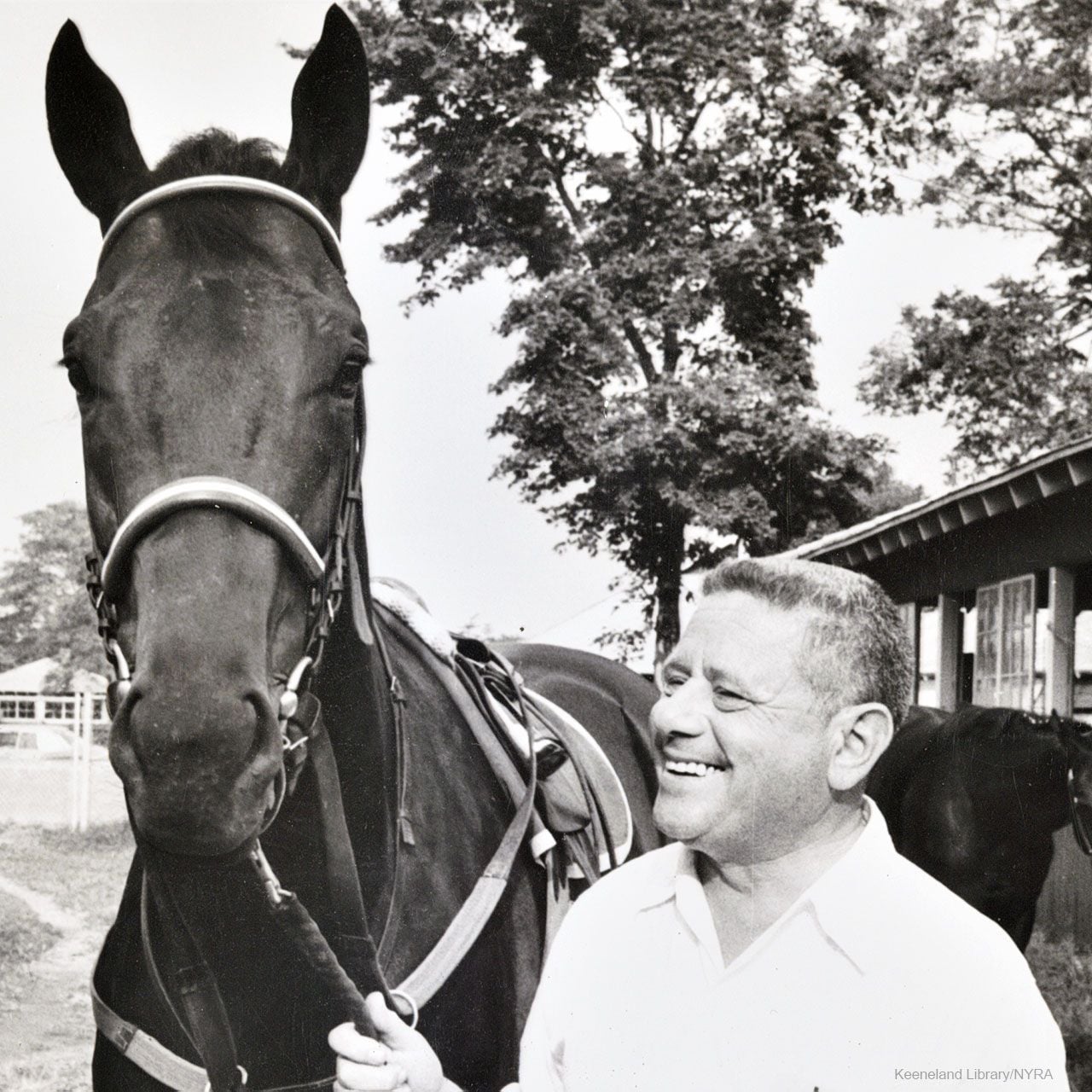
Carry Back and owner Jack Price at Belmont (Keeneland Library/NYRA)

Updated:
Let’s set the scene: Churchill Downs, the first weekend of May 1961. Thousands of fans decked out in their finest descend on Louisville, Ky., for the annual traditions of the Kentucky Oaks and Derby, two of America’s premier races for three-year-olds. Friday’s crowd endured record rainfall of 1.4 inches over the course of the day, while Saturday’s fans enjoyed a misty and cool spring day. While the weather might have been less than ideal, the races themselves were awash in excitement.
The 1961 Kentucky Oaks and Derby featured a pair of brothers, two close finishes, and a couple of interesting coincidences.
Brother vs. Brother
The Parke brothers—Vasco, Burley, Monte, Charles, and Ivan—were only five of the 12 children born to Julia and Anson Parke of Albion, Idaho, but all found fame in the racing game, starting with a turn in the saddle. After his jockey days were done, Vasco became a steward at various racetracks in the West, while Burley became a Hall of Fame trainer of horses like Noor; Monte also went from riding to conditioning before working as a clocker in his later years; and then Charles and Ivan also capitalized on their careers as riders to become famed trainers in their own right. In 1961, they found themselves competing against each other in the Kentucky Oaks.
Charles Parke replaced Ivan as trainer for Fred Hooper’s stable when the latter had to step away from training because of an illness. When Ivan returned to the barn, he went back into the employ of Pin Oak Stud. For the 87th Oaks, Ivan had the favorite in Play Time for Pin Oak while Charles brought My Portrait, a Hooper homebred, to the 1 1/16-mile stakes. Future Hall of Famer Johnny Sellers was tapped to ride Play Time while fellow Hall of Famer Braulio Baeza was named for My Portrait.
My Portrait broke from the outside of the field of 11 and went straight to the lead while Play Time, breaking from post 1 on the rail, tailed her in second. Baeza and My Portrait maintained at least a length lead throughout the 8 1/2 furlongs but had to repel a sustained drive from Play Time and Sellers. As the wire loomed in the foreground, Play Time put in one last bid to challenge My Portrait, who emerged victorious by a neck. Charles got his Oaks victory for owner Hooper over his brother Ivan, who had already notched a Derby victory for the same owner with Hoop Jr. in 1945. Sellers and Baeza did not have much time to reflect on their close finish; both were slated to ride in the Kentucky Derby the next day.
Short Margins
By 1961, Johnny Sellers was no stranger to the Kentucky Derby. The California native had ridden in the big race twice before, his sixth place on Cuvier Relic in the 1960 edition his best finish to that point. Though he had only been in the saddle about a half-dozen years at that point, Sellers already had several stakes wins under his belt. Baeza had emigrated to the United States from Panama a year earlier and was quickly rising through the ranks nationally. This was his first chance to compete in the Derby.
Sellers returned to Churchill Downs Saturday to ride Carry Back, the Florida-bred son of Saggy, in the Derby while Baeza was set to pilot Crozier for Hooper, to whom he was under contract. Carry Back, owned by Katherine and Jack Pierce and bred and trained by Jack, came to Louisville as the favorite after his win in the Florida Derby and second in the Wood Memorial. Crozier arrived with second-place finishes to Carry Back in the Flamingo Stakes and the Florida Derby on his resume and entered the gate as second-choice behind the Florida-bred.
Derby Day debuted chilly and misty, the track still recovering from its inundation the day before. By the time the field entered the gate at 4:31 p.m., the track was rated good as the horses were sent away quickly, Globemaster taking the lead from the jump. Baeza had Crozier chilling back in third while Sellers and Carry Back were toward the back of the pack in 11th. Into the stretch, Baeza moved Crozier to the lead, his advantage a half length as the field approached the final furlong. Sellers had swung wide on the far turn, seeking a good running path for Carry Back, who mounted his usual late run.
As Crozier cruised toward the wire, Baeza poised to win his first Derby and give Hooper his much-desired second victory, Sellers and Carry Back were furiously gaining on the pair. The favorite’s momentum carried him past Crozier despite Baeza’s best efforts, hitting the wire a winner by a neck – the same margin that Baeza on My Portrait had gotten the better of Sellers on Play Time the day before. The neck margins between Sellers and Baeza in both the Oaks and the Derby were fun coincidences that marked the 1961 editions as unique in the long history of these two iconic features.
Crozier’s second was the closest Hooper would come to winning another Derby after his 1945 victory. Carry Back would go on to win the Preakness and then fall short of the Triple Crown when he finished seventh behind Sherluck in the Belmont. The Florida-bred champion would go on to win the Whitney Stakes and more and earn a spot in the National Museum of Racing and Hall of Fame. Hooper’s Crozier would leave his mark on the sport with his son, Precisionist, Breeders’ Cup Sprint (G1) winner, Champion Sprinter, and Hall of Fame.