What are payouts? Here’s the math and how you can use them in betting
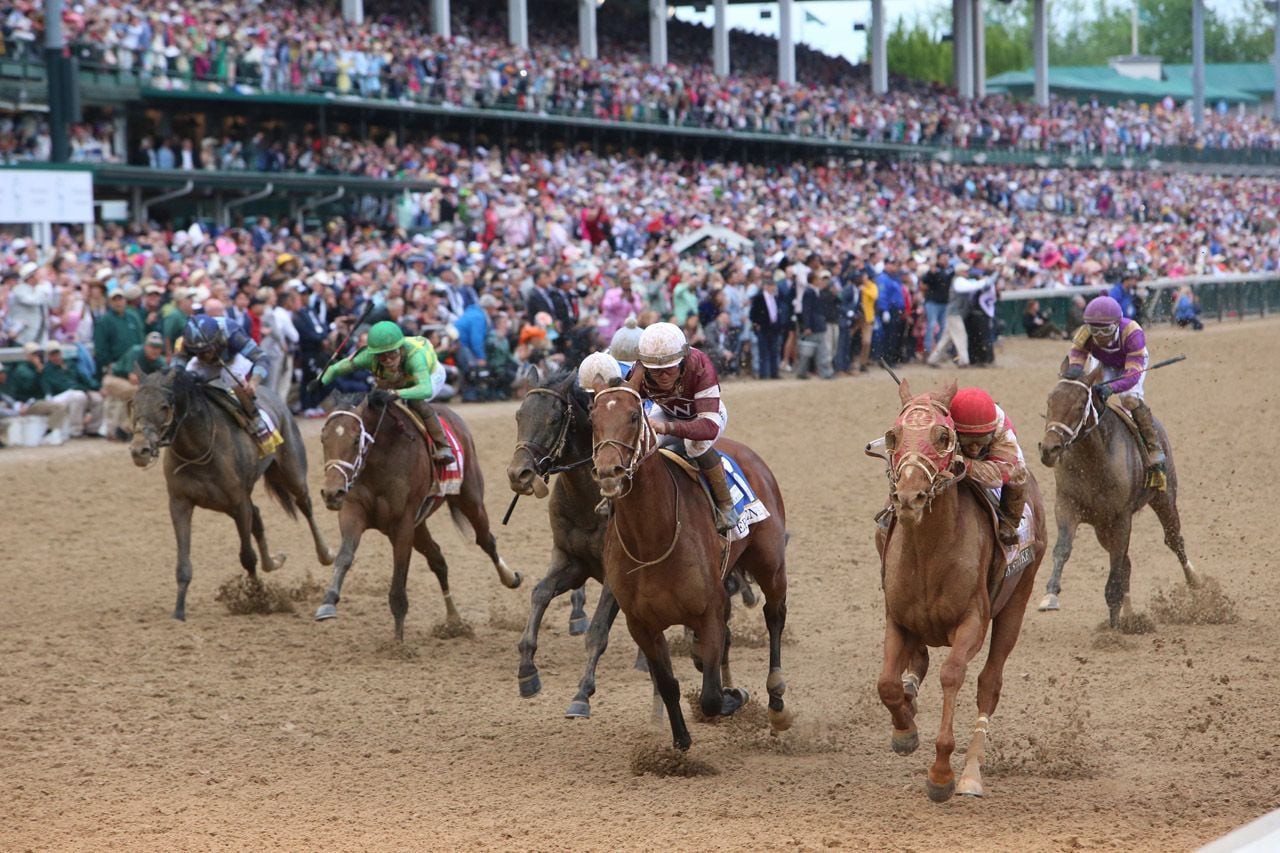
Rich Strike with Sonny Leon aboard wins the 148th Kentucky Derby at Churchill Downs (Photo by Horsephotos.com)

Updated:
In horse racing betting, what are payouts? How do payouts work? And how can you use them to place smarter bets? Get out your calculator and prepare your spreadsheets, because we’re in for some math.
What are payouts?
In horse racing, a payout is the money returned by a winning bet. If you place a $2 win bet on a horse at 4-1 odds, and that horse finishes first, your $2 win bet will return $10, and the $10 is the payout.
How are payouts calculated?
Most horse racing betting, including the betting offered on TwinSpires.com, is pari-mutuel betting. Under this system, all bets of a given type—for example, win bets—are grouped into a single pool. After a certain percentage of the pool (the takeout) is removed to pay taxes, fund racing operations, etc., the remainder of the pool is distributed to winning bettors.
Here’s an example: let’s say $100,000 is wagered into a trifecta pool with a $1 minimum bet amount. The takeout rate is 20%, so $20,000 is removed, leaving $80,000. A total of 640 trifecta tickets contain the winning combination; assuming each winning trifecta features the $1 minimum bet amount (unrealistic, yes, but bear with our example), each winning ticket delivers a $125 payout ($80,000 ÷ 640 = $125).
How can payouts be used to plan stronger bets?
Obviously, payouts can vary widely from race to race. If one race is won by a horse starting at 2-1 odds, and an 80-1 longshot wins another, the payouts for the race with the longshot winner will be much higher since few bettors will have predicted the winning outcome.
However, bettors can review the average or median payouts generated in the long run from a particular racetrack or graded stakes to determine how much money they should invest in their bets.
Consider the Kentucky Derby (G1) as an example. The Kentucky Derby is arguably the greatest betting race in North America. Millions of dollars are wagered, and payouts can be huge.
The superfecta is a bet requiring bettors to select the top four finishers in order. Since 2015, the $1 superfecta in the Kentucky Derby has produced an average payout of $46,602.84 (a return of 46,601-1) and a median payout of $9,456.40 (a return of 9,455-1).
The lowest Kentucky Derby superfecta payout since 2015 was $542.10 in 2016, when the top four favorites (led by 2-1 favorite Nyquist) ran 1-2-3-4 in order of their odds. Yes—the absolute most predictable outcome still generated a $542.10 payout for a $1 ticket.
Meanwhile, the highest superfecta payout since 2015 was $321,500.10, generated when Rich Strike finished first at 80-1 in 2022.
These numbers provide Kentucky Derby superfecta bettors with guidelines for how much they should bet. They can reasonably invest a few hundred dollars, knowing that if they cash a winning ticket, it’s unlikely to pay less than $500 and could potentially yield a life-changing, six-figure payout.
These large payouts are possible in part because the Kentucky Derby superfecta pool typically draws over $10 million in bets. Now, contrast the Kentucky Derby payouts with those generated by an average day of racing at a track with small betting pools—we’ll use Fonner Park in Nebraska as an example.
On April 19, 2026, Fonner Park offered superfecta betting in six races. The minimum bet amount was 10 cents. The average payout was $583.83 (a return of 5,837-1), and the median payout was $50.73 (a return of 506-1). The lowest payout was $2.39; the highest was $3,245.37. All these numbers are significantly lower than the corresponding numbers from the Kentucky Derby.
A big reason is the small pools at Fonner Park. The largest superfecta pool was $4,329; after 25% takeout was subtracted, one bettor assembled a winning ticket with a 29-1 longshot on top and cashed the day’s biggest payout, $3,245.37.
By examining the payouts and pool sizes at Fonner Park, superfecta bettors can see that spending hundreds in search of a winning ticket isn’t a wise strategy—not when the median payout on a random day was around $50, and the maximum you could win was just over $3,200. Depending on whether you expect favorites or longshots to prevail, betting anywhere from $1 to $15 or $20 would be more in line with the prospective payouts for Fonner Park superfectas.
Everyone likes to cash big payouts. But learning how payouts are calculated, and how pool sizes impact payouts, will make you a better bettor whether you’re chasing a $10 win payout or a $300,000 superfecta.
ADVERTISEMENT