Top 10 storylines for 2026 Prix de l’Arc de Triomphe
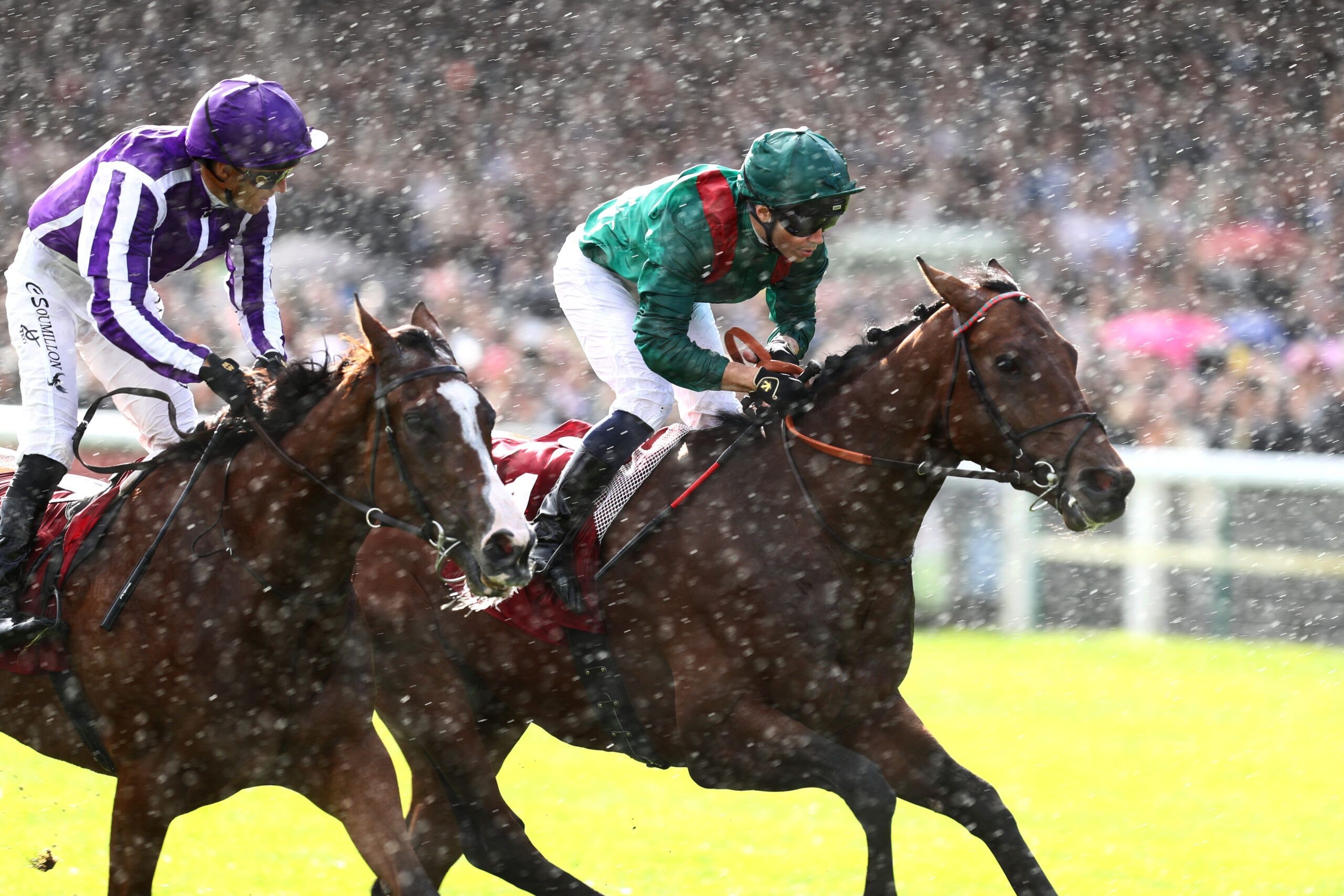
Daryz collars Minnie Hauk in the Prix de l'Arc de Triomphe (G1) (Photo by Scoopdyga/France Galop)

Can Daryz join the all-time greats by winning the Prix de l’Arc de Triomphe (G1) for the second time? The betting suggests that the Aga Khan flagbearer has Europe’s about 1 1/2-mile championship at his mercy, but there’s no shortage of challengers amassing at ParisLongchamp on Sunday.
After an unusually dry September, the ground is forecast to be quicker than the norm for the first Sunday in October. This is also the last running restricted to entire males and fillies, with the doors opening to geldings in 2027.
Let’s look at Daryz’s historic task and the other major storylines surrounding the 105th Arc.
Daryz seeks to enter the pantheon
Eight horses have won the Arc twice. If you remove the femme fatales Corrida (1936-37), Treve (2013-14), and Enable (2017-18), you’re left with a list of just five colts to achieve the feat – *Ksar (1921-22); Motrico (1930 and 1932); Tantieme (1950-51); *Ribot (1955-56); and Alleged (1977-78).
While the historical obstacle is weighty, it’s not as dire when viewed in context. Outstanding colts are often retired to stud, diminishing the pool of prospective repeat winners.
Since Alleged, eight colts have tried to defend their Arc titles. Sagace would have emulated him as a two-time winner if he hadn’t been disqualified for bothering Rainbow Quest in 1985.
Of the remaining seven, Carnegie and Helissio finished sixth in 1995 and 1997, respectively; Montjeu wound up fourth in 2000; Bago was third in 2005; Hurricane Run was promoted to third in 2006; Workforce regressed to 12th in 2011; and Torquator Tasso placed third in 2022.
Daryz may have a stronger case to succeed than most of those dethroned champions. As a later-developing three-year-old who was just beginning to blossom by Arc time, he carried his form into brilliant performances early in his four-year-old campaign. He was reportedly under the weather when suffering his blip at Royal Ascot, but back in business in an easy prep in the Prix Foy (G2), dispatching Bay City Roller.
Trainer Francis-Henri Graffard has said that Daryz is even sharper coming out of the Foy, and he’s by no means looking for the very soft going of last year’s Arc. On the contrary, he welcomes the quicker ground to showcase the colt’s turn of foot:
“In terms of physique and acceleration, I think he is the best horse I have trained so far,” Graffard told france-galop.com, effectively preferring Daryz to stablemate Calandagan, the world’s top-rated horse of 2025.
Daryz avoided one possible pitfall – the draw – by landing in a favorable post 5. No wonder the son of 2009 Arc legend Sea the Stars is well fancied to add a record-extending ninth win for the Aga Khan’s operation.
Still, it would be a monumental historic accomplishment, and at the price, it makes sense to look for alternatives with better value.
Diamond Necklace must sparkle to overcome post 16
Diamond Necklace has the right profile as a top-class three-year-old filly who will receive 10 pounds from Daryz and the other older males. Proven around this course, the dual French classic heroine was expected to spearhead the Aidan O’Brien brigade.
But as soon as she was marooned in the far outside post 16, Diamond Necklace began to lose support. Ryan Moore jumped ship, and the inevitable market reaction ensued.
On the other hand, Diamond Necklace reunites with her old partner Christophe Soumillon, who rode her when Moore was injured last fall. “Soumi” raved about the blueblood daughter of St Mark’s Basilica, and I have an inkling that he’ll find a way to mitigate the damage from the draw. At the risk of refusing to bow to reality, I don’t want the post to lure me off a filly that I otherwise have loved from her juvenile days.
Diamond Necklace was unbeaten until her recent second in the Prix Jean et Louis Romanet (G1) at Deauville. The winner, Aventure, is no slouch, having finished second in the 2024 Arc to Bluestocking, and she’s had a renaissance cutting back in trip this season. The Romanet third-placer, Timeforshowcasing, had just split Hotazhell and Wimbledon Hawkeye – the future exacta in the Irish Champion (G1) – at Munich.
As useful as that form looks, it’s even better if you take the view (as I do) that Diamond Necklace wasn’t at her best that day. She was wheeling back from a stellar display in the Nassau (G1) at Glorious Goodwood, where she cantered all over Friendly Soul, who came right back to win the Prix Vermeille (G1) in stakes-record time. O’Brien said he’d gone easy on Diamond Necklace between those races, and she may have had the bug going around the yard at the time.
Whatever the underlying reason, we didn’t see the real Diamond Necklace at Deauville. If we see the one from Glorious Goodwood, she has the gears to be special – assuming she stays the Arc distance.
Moore on Benvenuto Cellini
Benvenuto Cellini’s Arc chances appeared to be dented by a fifth behind Varandir in the Prix Niel (G2), but he’s got Moore in his corner after drawing post 1. While it’s possible that he was harboring the bug during that loss, his body language left the distinct impression that he wasn’t loving the track. He was hanging with an ungainly head carriage.
Although Benvenuto Cellini has performed well at other right-handed tracks – as the Irish Derby (G1) winner and as a respectable third to Kalpana and Calandagan in the King George VI & Queen Elizabeth (G1) at Ascot – it’s difficult to trust him on this particular circuit after the Niel.
O’Brien has long described the son of Frankel and Newspaperofrecord as tailor-made for the Breeders’ Cup Turf (G1), and my suspicion is that we’ll see him to best effect at Keeneland. Indeed, Benvenuto Cellini has always looked most impressive going left-handed.
Minnie Hauk hopes to hit the high note this time
Just denied by Daryz as the favorite here last year, Minnie Hauk returns with a lower profile after a less compelling 2026 campaign. But she’s been compromised by foot issues, and O’Brien insists that her entire year has been planned to peak for the Arc.
It’s significant that O’Brien’s only two Arc winners were both four-year-olds, Dylan Thomas (2007) and Found (2016). Minnie Hauk fits that demographic, while sophomore stablemates Diamond Necklace and Benvenuto Cellini will have to defy history.
If one can never discount O’Brien’s mastery at hitting the ordained target, I can’t get past the idea that her best shot has come and gone. There’s also the booking of Godolphin’s own William Buick as her rider, rather than a jockey more often glimpsed in the Coolmore orbit.
Is Thundering On this year’s Minnie Hauk?
In that respect, note that a rider with Ballydoyle links, Pierre-Charles Boudot, has picked up the mount on Joseph O’Brien’s Thundering On. She could be this year’s Minnie Hauk. A fellow Frankel filly who impressed in the Oaks (G1) at Epsom, Shapoor Mistry’s homebred departed from the usual path by subsequently shortening up in trip.
The one concern is that Thundering On might have preferred to have the typical Arc ground with at least some give in it. But she does have a powerful kick and the same 10-pound weight break as Diamond Necklace. She also left Timeforshowcasing back in fourth in her recent Blandford (G2) score.
Kalpana’s a different horse from last year
Last year’s seventh-placer, Kalpana, returns to the scene in the form of her life. The Andrew Balding mare had excuses with a poor draw in 2025, and a lost cheekpiece along the way, and she wasn’t disgraced to lose by seven lengths.
Nearly flawless since, Kalpana has already turned one very notable table when dethroning Calandagan in the King George. And she’s got a much better post 6 to go along with her superior form.
My only quibble is that most of Kalpana’s signature wins have come at Ascot. She can look more vulnerable elsewhere, especially if Colin Keane moves a trifle too soon. Maybe that’s clutching at straws for an otherwise logical contender who’s reportedly an all-around better, stronger operator at the age of five.
If Kalpana crowns her year, she’d give Juddmonte a record-tying eighth Arc to join the Aga Khan family atop the all-time standings.
Is Varandir this year’s Daryz?
The Aga Khan team has another proper player in Varandir, who has echoes of Daryz from last year with the improving three-year-old vibe. Likewise nurtured along by Graffard, Varandir sustained his only loss when a close fourth to Maltese Cross in the course-and-distance Grand Prix de Paris (G1).
When next seen in the Niel, however, Varandir took a step forward to win in a fast time of 2:25.70. He was almost as quick as Friendly Soul’s Vermeille (2:25.46), both considerably faster than the pedestrian pace of the Foy.
Graffard told france-galop.com that Varandir was transformed from being immature both physically and mentally. The rub is whether he’s progressed enough to spring the upset. I’d underestimated Daryz in this very department.
Maltese Cross must buck more historical trends than post 11
According to Racing Post stats that go back to 1988, post 11 has produced no Arc winners. That may have caused some angst for fans of Maltese Cross, but I’m more stuck on his pathway here. You have to go back a couple of decades, or longer, to find an Arc winner who graduated from the Grand Prix de Paris or the Great Voltigeur (G2).
To be fair, there’s also been a trend against the Niel. Rail Link (2006) was the last winner of the Niel to capture the Arc in the same year, and he also happens to be the most recent Grand Prix de Paris hero to do so.
But the Great Voltigeur, traditionally a stepping stone to the St Leger (G1), isn’t the typical tune-up found on an Arc winner’s resume. Rainbow Quest won the 1984 Great Voltigeur the year prior to his Arc promotion. You have to go back to Alleged himself to find a Great Voltigeur/Arc double, and in between, he suffered his only career loss in the 1977 St Leger.
Moreover, Maltese Cross would be a highly unusual Epsom Derby (G1) runner-up to win the Arc later that same season. Since the great Dancing Brave last accomplished it 40 years ago, other Derby placers have managed to win the Arc as older horses – Sakhee (2001) and Dylan Thomas. It’s similarly rare if you go deep into Arc history. Parth (1923) placed at Epsom before winning the Arc at three, but others with Epsom placings didn’t win the Arc until the following year (*Migoli in 1948, *Ballymoss in 1958, and Rheingold in 1973).
If Maltese Cross has to buck history to win, his overall profile nevertheless stamps him as a high-class sophomore. Trainer William Haggas has said he’s getting better with every race, showing more finishing speed, and sharing the trait of sire Sea the Stars not to run up gaudy margins.
The cautionary note is that Maltese Cross doesn’t offer as much value as others in here, especially with his price assuming greater clarity in the three-year-old pecking order than warranted. Saturday’s Canadian International (G1) could boost the Grand Prix form if Ancient Egypt topples elders Purview and Arabian Crown at Woodbine.
Japan arrives under the radar
Unlike past years when Japanese superstars chased an elusive Arc trophy, the 2026 hopefuls don’t arrive with the same swagger. It would be ironic if a lesser light should score the historic breakthrough after the failures of such legends as Deep Impact and Orfevre. But their closest margin of defeat came with the relatively unheralded Nakayama Festa, who missed by a head to Workforce in 2010.
Meisho Tabaru is the more accomplished representative as a two-time Takarazuka Kinen (G1) winner, like his mercurial sire Gold Ship, an Arc also-ran in 2014. With his forward running style and fondness for right-handed Hanshin, he might give iconic jockey Yutake Take a bold sight for some way. Yet Meisho Tabaru’s overall form is inconsistent, his stamina is a question mark, and he won’t be able to leverage his effectiveness on rain-softened ground here.
Admire Terra is considered the bigger longshot, but I think he has a chance to crash the exotics at crazy odds. Trainer Yasuo Tomomichi has described the lessons he’s learned from past Arc attempts, including the benefits of prepping at home rather than in France, and most of all, selecting the right type of horse to adapt to Longchamp.
We’d know more if Admire Terra hadn’t lost his rider out of the gate in last fall’s Japan Cup (G1). Nevertheless, the gray worked out a trip for himself and matched strides with Calandagan and Masquerade Ball to the wire in record time for about 1 1/2 miles.
Yet it’s tantalizing to think that Admire Terra could be capable with the weight on his back too. Classic-placed in 2024 and a close third to Croix du Nord in the Tenno Sho Spring (G1), he ran a better-than-appears prep when ninth in the Sapporo Kinen (G2) in course-record time.
Having two-time Arc winner Cristian Demuro in the saddle is a plus, and there’s also a sentimental pedigree angle. Not only does Admire Terra hail from the family of Deep Impact, but so does his own sire, Rey de Oro. Thus Admire Terra is inbred to Deep Impact’s dam, Wind in Her Hair.
Rouget bows out, ARM carries on
Demuro’s Arc wins came aboard Sottsass (2020) and Ace Impact (2023) for the prolific horseman Jean-Claude Rouget, who will retire from training after sending out Arrow Eagle in the Arc. Arrow Eagle is a fitting final runner, as a half-brother to Ace Impact.
A creditable sixth in last year’s Arc on his preferred very soft ground, Arrow Eagle went on to take the Prix Royal-Oak (G1) for marathoners. He’s liable to find the ground too quick for a fairy tale ending at this distance, and it’s mission accomplished just to give Rouget a grand farewell on French racing’s biggest day.
The most poignant runner of all, Saddadd, will try to pay tribute to his late owner/breeder, Sheikh Ahmed, who just passed away a couple of weeks ago. A lightly-raced improver for Roger Varian, Saddadd gave him his last Group 1 tally in the Grosser Preis von Baden (G1), which has been known to produce the occasional Arc surprise. His familiar yellow silks now carry on under the name of ARM Racing.
ADVERTISEMENT