Which running style wins the most Kentucky Derbys: Frontrunners, stalkers, or closers?
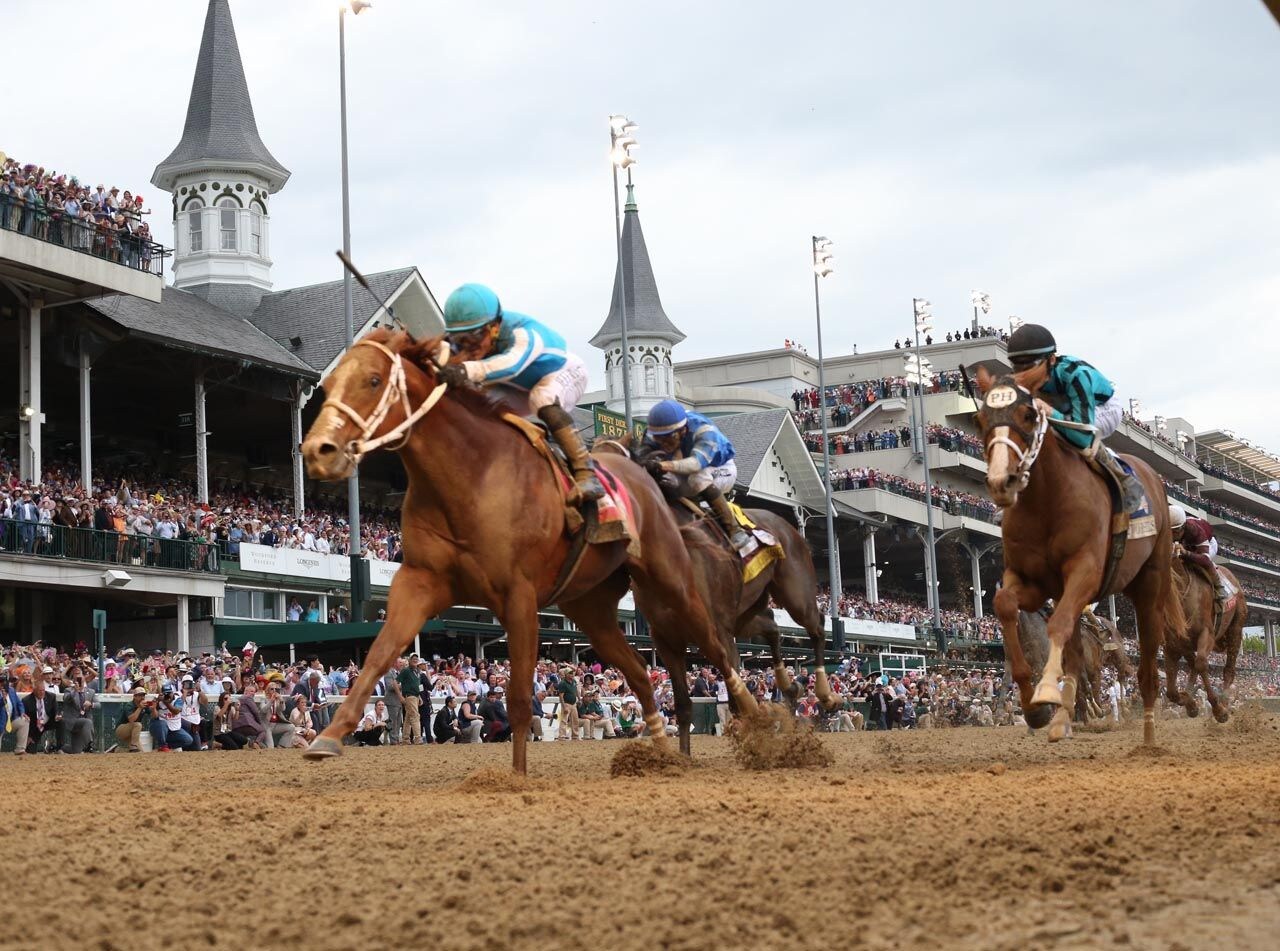
Mage with Javier Castellano riding wins the 2023 Kentucky Derby (G1) at Churchill Downs (Photo by Horsephotos.com)

Updated:
When 20 talented racehorses vie for victory in the Kentucky Derby (G1), which running style is most likely to succeed?
Will the race go to a frontrunner who seizes the lead and stays out of trouble? A stalker who settles behind the leaders before pouncing to the front? Or a late runner who conserves energy early before rallying down the homestretch?
It’s a tricky question to answer. The Kentucky Derby boasts a long history dating back to 1875. Through the decades, the race has changed in meaningful ways. For example:
- The definition of a gate-to-wire winner has shifted. Prior to 1960, a horse was required to leave the starting gate quickest in order to count as the early leader. Since 1960, a horse needs only to make the front by the end of the opening quarter-mile to count as the early leader.
- The Kentucky Derby field size has varied widely through the years. In the early decades, field sizes were much smaller than today, with as few as three horses competing. Through the years, there have been 23 gate-to-wire Kentucky Derby winners, but 14 of those achieved their wins prior to 1927.
As a result, studying running style statistics from the full 151 years of Kentucky Derby history fails to illustrate where the race stands today. That’s why we’re going to take a deep dive into the statistics, researching the most effective running styles methodically to deliver answers applicable to modern-day Kentucky Derbys.
Research methodology
First, we must choose a relevant time period of Kentucky Derby history to study. We chose 2000-2025. The last 26 editions of the Kentucky Derby have been largely consistent in terms of field size; 23 out of 26 contained between 18 and 20 horses, and none featured fewer than 15 horses. This stands in contrast to the 1990s, when field size varied considerably from year to year and dropped as low as 13 horses in 1997.
Next, we’ll group the 26 Kentucky Derby winners into six categories, based on where they were positioned at the six official points of call in the result charts: the 1/4-mile call, the 1/2-mile call, the 3/4-mile call, the mile call, the stretch (1 1/8-mile) call, and the finish call.
The six categories we’ve chosen are as follows:
- Horses that led all the way.
- Horses that raced in the front five throughout, but did not lead all the way.
- Horses that raced in the front half of the field throughout, but who raced outside the front five at some point.
- Horses that raced in the back half of the field throughout, but who avoided dropping into the back five of the field.
- Horses that raced in the back five at some point, but who avoided trailing the field.
- Horses that trailed the field at some point.
Now we’ll compare the results of each category to determine which running styles produce the most Kentucky Derby winners.
Data analysis
The 26 Kentucky Derby winners break down into our six categories as follows:
| Gate to wire winner | Front 5 throughout | Front half throughout | Back half at some point | Back 5 at some point | Trailed at some point |
| War Emblem | Funny Cide | Big Brown | Animal Kingdom | Fusaichi Pegasus | Mine That Bird |
| Authentic | Smarty Jones | Super Saver | Monarchos | ||
| Barbaro | I'll Have Another | Giacomo | |||
| California Chrome | Country House | Street Sense | |||
| American Pharoah | Mystik Dan | Orb | |||
| Nyquist | Rich Strike | ||||
| Always Dreaming | Mage | ||||
| Justify | Sovereignty | ||||
| Mandaloun |
Immediately, several takeaways are obvious:
- In this day and age, it’s difficult to win the Kentucky Derby in gate-to-wire fashion. Out of 26 Kentucky Derby winners in our sample size, only two (8%) led all the way: War Emblem and Authentic. Of course, only one horse per year has a chance to lead from start to finish, so that’s a caveat to keep in mind.
- It’s even harder to win the Kentucky Derby while rallying from last place. Among Kentucky Derby winners since 2000, only one (4%)—Mine That Bird—has achieved the feat.
- Horses that raced in the front five throughout, without leading from start to finish, have enjoyed the most success in the Kentucky Derby since 2000. Nine out of 26 winners (35%) utilized this running style.
- That said, horses who raced in the back five at some point (without trailing the field) have also done well. This category has yielded eight out of 26 Kentucky Derby winners (31%) since 2000.
- The back end of midfield rarely produces Kentucky Derby winners. Out of 26 Derby winners since 2000, only one (4%)—Animal Kingdom—raced in the back half of the field without ever dropping into the back five.
By combining categories, broader trends become apparent. Horses who raced in the front half of the field throughout (including gate-to-wire winners and those who raced in the front five throughout) have won 16 out of 26 (62%) Kentucky Derbys since 2000. They’ve outperformed horses who raced in the back half of the field at some point; the latter category has produced 10 winners from 26 Derbys (38%).
| Front half throughout | Back half at some point |
| War Emblem | Fusaichi Pegasus |
| Funny Cide | Monarchos |
| Smarty Jones | Giacomo |
| Barbaro | Street Sense |
| Big Brown | Mine That Bird |
| Super Saver | Animal Kingdom |
| I'll Have Another | Orb |
| California Chrome | Rich Strike |
| American Pharoah | Mage |
| Nyquist | Sovereignty |
| Always Dreaming | |
| Justify | |
| Country House | |
| Authentic | |
| Mandaloun | |
| Mystik Dan |
Also, horses that raced in the front five throughout (including gate-to-wire winners) and horses that raced in the back five throughout (including trailers) have combined to win 20 out of 26 Kentucky Derbys (77%) in our sample size.
RELATED: 2026 Kentucky Derby Run Style Analysis
Conclusions
Since 2000, Kentucky Derby winners have been 1.6 times more likely to race in the front half of the field than the back half. Tactical speed is an asset in the Run for the Roses.
However, the greater takeaway is one of extremes. A whopping 77% of Kentucky Derby winners since 2000 raced either in the front five throughout or in the back five at some point in the race. Only 23% of Kentucky Derby winners employed the seemingly conservative “midfield” approach, racing outside of the front five at some point in the race, but without ever dropping into the back five.
To have the best chance at winning the Kentucky Derby, horses must commit to racing at one end of the pack or the other. Horses who raced in the front five throughout have won 11 out of 26 Derbys (42%) since 2000. Horses that raced in the back five at some point have won nine out of 26 Derbys (35%) during the same timeframe.
Stick close to the lead, or drop far behind. Those are the two running styles that win most Kentucky Derbys.