Tall Tales of the Track: A Tale of Two Colts Named Ladas
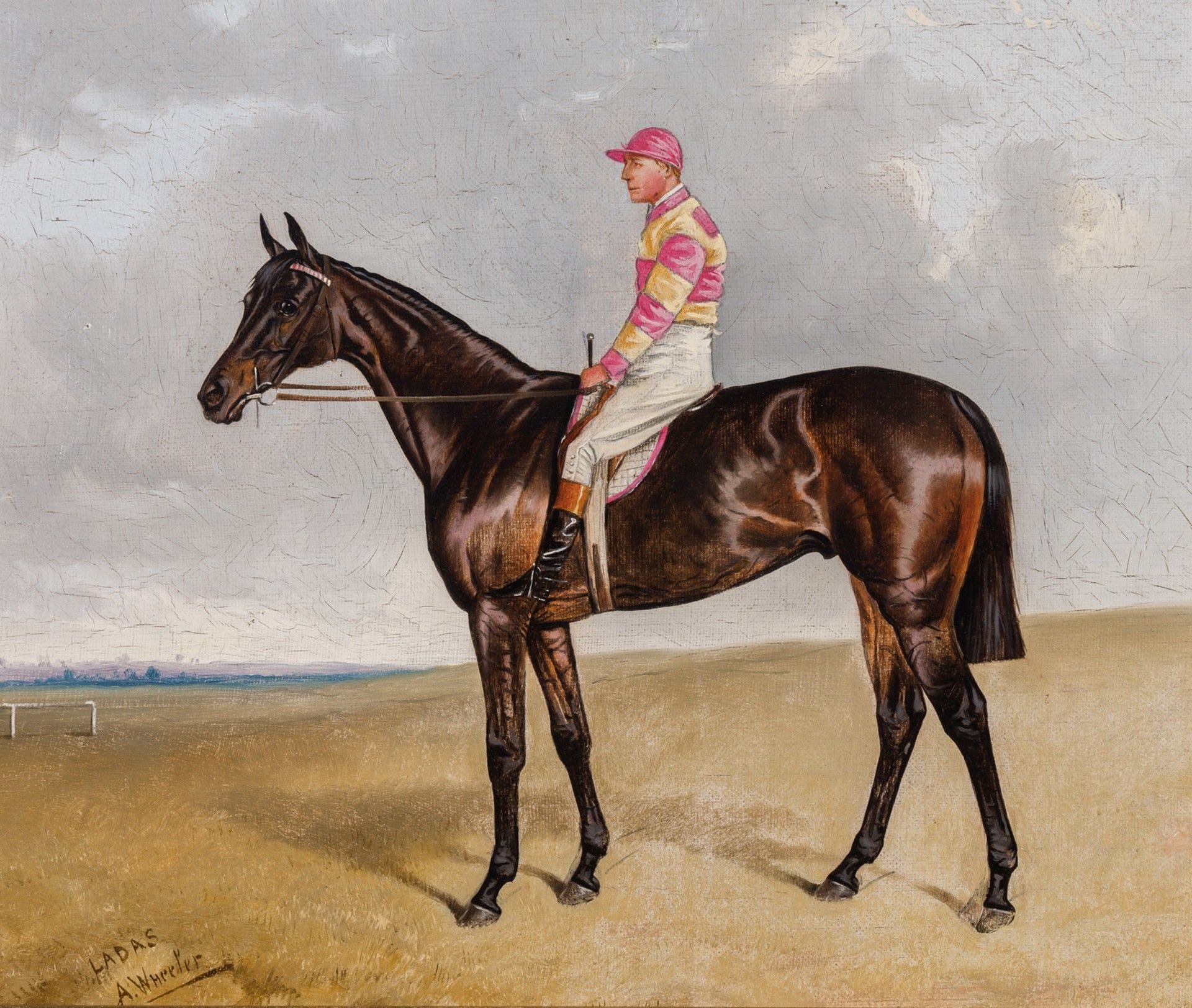

It is not uncommon in horse racing for more than one horse to share the same name. The 21st-century Arrogate was the second of his name, after the original from the 1950s. Sir Gallahad, the sire of Triple Crown winner Gallant Fox, was the third registered in the United States, while Nitrogen is not the first Thoroughbred registered with that name. Only the select few, like Triple Crown winners, have their names retired.
In the late 19th century, an English sportsman touted a horse named Ladas; when the first failed in a Classic race, he bestowed that moniker on another, who rose to the occasion on the biggest stage in British racing.
Ladas, the First
When Archibald John Primrose, 4th Earl of Rosebery, died on March 4, 1868, his son, Archibald Primrose, Lord Dalmeny, had predeceased him, leaving his grandson Archibald Philip Primrose to become the 5th Earl of Rosebery. A student at Christchurch, Oxford, the young man decided to use his new fortune to do something he had always wanted: he bought a racehorse.
The problem was that the university thought ownership was incompatible with the serious pursuit of knowledge, so they ordered the new Earl of Rosebery to sell his newly acquired equine athlete. However, Lord Rosebery thought they were bluffing, so he declined to follow through with their request; soon, the 21-year-old was kicked out, taking up his seat in the House of Lords and declaring that he had only three ambitions: to marry an heiress, to win the Derby, and to become Prime Minister.
That first racehorse was Ladas, a bay colt by Lambton out of the mare Zenobia. He purchased the undefeated colt for 3,500 guineas (or £15,000), with his sights set on victory at Epsom, and sent him to trainer James Dover’s yard at Ilsley for preparation. The problem was that other sons of Lambton had not quite shown themselves to be stayers, and the Derby was 12 furlongs. The field for the 1869 Derby numbered 22 horses, with John Johnstone’s Pretender coming out on top.
Ladas was an also-ran, a humiliating moment for the young Lord Rosebery. Still pursuing a Derby win, he would build a breeding and racing program that one day would yield a multitude of treasured victories.
Ladas, Again
In 1878, Lord Rosebery fulfilled his ambition to marry an heiress, making the richest woman in Britain, Hannah de Rothschild, the only child of Jewish banker Baron Mayer de Rothschild, his wife in a widely attended society wedding. The pair had four children, sons Albert and Neil and daughters Sybil and Margaret. Their marriage brought the breeder/owner Crafton Stud in Buckinghamshire, where the de Rothschilds bred horses like Favonius, a 1871 Derby winner, and Hannah, a multiple Classic winner.
Among his broodmares was Illuminata, who raced only at age two, winning her first start in a four-furlong race and racking up eight starts, including a second and a third, before being retired to stud. He paired her with the stellar stallion Hampton, whose sire had won the 1863 St. Leger and whose dam, Kettledrum, had won the 1861 Derby, and in 1891, Illuminata foaled a solid bay colt. He would start racing at two without a name, referred to only as the Illuminata colt for his first three races. He won on debut at the 1893 Derby meeting at Epsom, taking the Woodcote Stakes, and then followed that with a victory in the Coventry Stakes at Royal Ascot.
After a three-month break, the unnamed colt returned in September’s Champagne Stakes at Doncaster and won easily. Soon after, Lord Rosebery officially named him Ladas II, with a view to redeeming the first Ladas, whom the former Oxford student had encouraged his friends to bet on and who, of course, had left him humiliated. The idea was that this second Ladas would redeem the racing enthusiast and keep the promise he had made to his mates when he was younger.
Ladas II made his final start of his juvenile season in the Middle Park Plate at Newmarket, the year's most important two-year-old stakes race. Going off as the 1-5 favorite, he took the lead halfway through the six-furlong race and was never threatened, his victory making him the winter favorite for the 1894 Derby, putting Lord Rosebery closer to another of his three ambitions.
Derby Dreams
In the days leading up to Ladas II’s turn in the Derby, Lord Rosebery also had political matters to deal with. As a member of the House of Lords, he was part of the Liberal coalition behind William Gladstone, who was serving his fourth turn as Prime Minister. The PM’s opposition to a naval spending bill caused a rift within his Cabinet, which led to his resignation on March 2, 1894. His successor usually would be someone selected by the outgoing PM or by the monarch, in this case, Queen Victoria. However, because of the contentious nature of Gladstone’s departure, she did not ask for his recommendation and instead asked Lord Rosebery to form a government.
He took office as Prime Minister on March 5, 1894; his tenure at the top of the British government was short-lived, lasting only 15 months, but he had achieved two of the three ambitions he had laid out for himself years earlier. The only thing left was to win the Derby. Ladas II started his three-year-old season with the Two Thousand Guineas at Newmarket. Over the straight mile, the Rosebery colt raced toward the back of the pack early, moved into third at the half-mile mark, and then battled Matchbox for the lead until the latter gave way, Ladas II winning by a length and a half.
He then started in the Newmarket Stakes on May 23, taking the 10-furlong feature with ease and shortening his Derby odds even more. Facing a field of just six others, Ladas II went to the starting line as the 2-9 favorite. Jockey John Watts held the colt back in midpack early and then challenged the leading Matchbox in the straight. He looked set to pass Matchbox and coast to victory, but the latter responded and put pressure on Ladas II inside the final quarter. The Rosebery colt shook him off in the final furlong and sailed to a 1 1/2-length win. The 5th Earl of Rosebery had his Derby.
Ladas II was denied his Triple Crown in the St. Leger when Throstle beat him by three-quarters of a length at Doncaster. After a four-year-old season beset by soundness issues, Rosebery retired his Derby winner to stud, where he sired Classic winners Gorgos and Troutbeck.
Lord Rosebery would go on to win two more Derbys, with Sir Visto (1895) and Cicero (1905). The three were buried at The Durdans, his Epsom estate, where their graves remain, marked by ornamental iron railings. After his short tenure as Prime Minister, he remained in the House of Lords and pursued his sporting life as an owner until he died in 1929.
ADVERTISEMENT