Tall Tales of the Track – Second on the list, first at the wire

Updated:
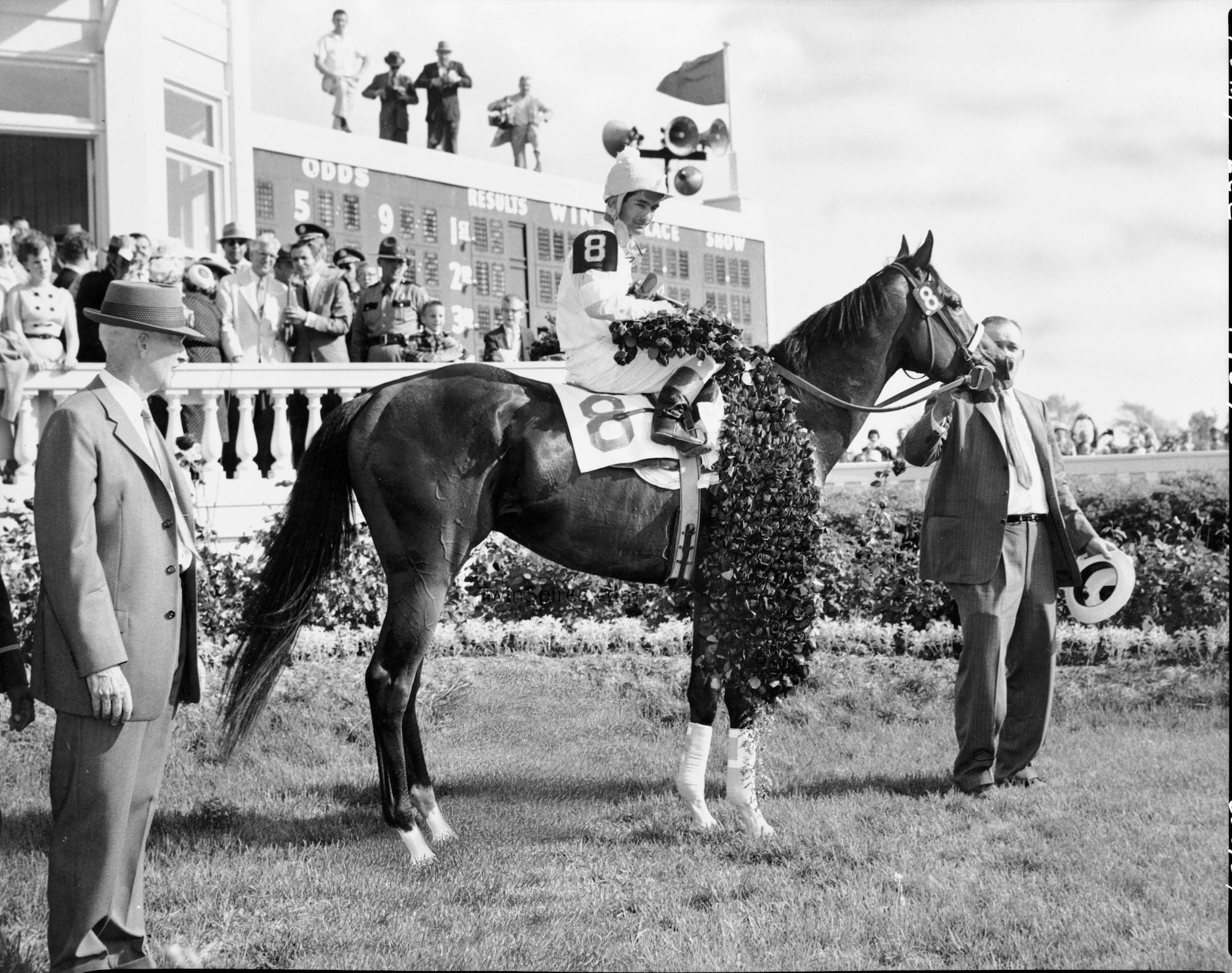
The British-bred Tomy Lee made history by winning the 1959 Kentucky Derby, becoming one of the rare European-bred horses to triumph in America's most celebrated race. His journey to the winner’s circle under the famed Twin Spires originated with a serendipitous decision that would prove to be one of the great bargains in thoroughbred history. What began as a practical solution to keep another colt comfortable during a transatlantic voyage ended with the unlikely companion stealing the spotlight, as Tomy Lee went on to outshine his stablemate and etch his name into Kentucky Derby lore.
Maybe This One Too
Bertie Kerr was more than a bloodstock agent: he had also been an accomplished footballer, playing for Bohemian Football Club of Dublin and also for the Irish football team that competed at the 1924 Olympics in Paris. In 1920, though, in the midst of his playing career, the 24-year-old started an insurance and bloodstock agency that continues to this day, thanks to his nephew Bert. The former footballer worked with owners from all over the world, including an American named Fred Turner.
Texas native Turner had made his fortune in oil after growing up on his family’s farm in Coleman County. He later bought his own ranch near Midland and started buying Thoroughbreds to bolster his cow-pony stock. That led to racing in California and, later, to buying horses for his racing stable. When he had trouble finding horses he liked stateside, he decided to invest in British and Irish stock, and that led him to the oilman Bertie Kerr.
He tasked Kerr with buying a weanling by Tulyar, winner of the 1952 Derby and St. Leger Stakes, at the 1956 Newmarket December sale. Believing that horses needed traveling companions, Turner also had a second weanling he wanted to purchase, but Kerr was not keen on his client’s choice and cabled him with his concerns. He identified another candidate for the oilman, a colt by Tudor Minstrel out of Auld Alliance. This candidate’s sire was the son and grandson of Derby winners but had done his best racing at a mile, winning the 1947 Two Thousand Guineas. His damsire Brantôme counted the Poule d'Essai des Poulains and the Prix de l'Arc de Triomphe among his 12 career victories. When Kerr cabled Turner about this second weanling, the oilman replied, “Buy him if you like him and go up to $15,000.”
When the hammer fell on the Tudor Minstrel-Auld Alliance colt, Kerr got him for 2,200 guineas, or about $7,000, alongside the $25,000 Turner paid for the Tulyar colt. The pair was shipped to the United States and the barn of trainer Frank Childs.
Surprise, Surprise
Childs was a third-generation horseman with West Coast roots. His father, Lewis, had been a successful breeder, trainer, and driver of Standardbreds, while his grandfather and great-uncle Jimmy Welch were both involved with harness horses; Welch was credited with introducing Standardbreds to California in 1859. Childs also started in harness racing, making his name as a Golden State-based trainer and driver in the years before World War I. After the war, he went into construction before turning to training Thoroughbreds in the 1930s. Turner tapped Childs as his trainer in 1955.
The pair of Newmarket colts that Turner bought were named Tuleg, partly after the sire Tulyar, and Tomy Lee, the latter originally named Tommy Lee, but upon learning that name was already registered, one of the M’s was dropped, but the pronunciation remained the same.
As a two-year-old, Tomy Lee outperformed his more valuable stablemate. He won six of eight races, including the Charles S. Howard, Haggin, and Starlet Stakes as well as the Del Mar Futurity, never finishing out of the money in his first season, and earned $213,460. At the end of the 1958 season, he was second on the list of top juveniles, ranked below First Landing, the Meadow Stable colt who won six stakes that year and later would sire a Kentucky Derby and Belmont Stakes winner in Riva Ridge. Tuleg, on the other hand, had been injured when another horse kicked him in the shoulder and did not make his first start until his three-year-old season.
Tomy Lee went into 1959 with Turner’s hopes riding along with him, though Tuleg was still in the conversation for a spot in the field alongside his stablemate. The latter made his debut on Jan. 3 but did not break his maiden until his third start, 11 days later. Tomy Lee, meanwhile, started his season with two consecutive seconds in first at the San Vicente and then the San Felipe. A minor injury prompted Childs to give his sophomore star a two-month break, so he sent his star east to Kentucky to prepare for the Kentucky Derby. Tomy Lee started with a track-record victory in the Stepping Stone Purse before following that up with a half-length win in the Blue Grass Stakes.
Tuleg, meanwhile, was having a rough go of it. Childs was still pointing him for the Derby as well, though the colt was not quite living up to the promise of his pedigree. He finished second in three of his six starts after breaking his maiden and then went east with Tomy Lee. His lead-up to the spring classics ended in the Palmeadow Purse at Keeneland, where he bowed a tendon and finished last of seven. Meanwhile, Tomy Lee entered the gate on the first Saturday of May as the race’s second choice behind Chenery’s First Landing. After a tight stretch battle with Sword Dancer and a 17-minute wait as stewards considered jockey Bill Boland’s claim of foul, Tomy Lee and jockey Bill Shoemaker savored a victory in the year’s biggest race. He was the second horse bred outside of the United States to take home the roses.
Second Chance
After a hard race at Churchill Downs, Tomy Lee skipped the rest of the Triple Crown series and returned home to California. He did not win another stakes race after his Derby victory and then retired to stud, where he experienced sterility. Though he did return to racing, he was not quite the same horse and retired for good with a record of 31-14-4-3 and $405,014 in money won. Tuleg did not fare much better, ending his career with a record of 10-1-3-1.
The Turner family’s connection to the Kentucky Derby continued through Fred’s daughter Dorothy. Her husband, Clarence Scharbauer, bought a yearling by Alydar out of the stakes-placed Bel Sheba for $500,000 from the 1985 Keeneland July Yearling Sale. Racing in Dorothy’s and her daughter Pam’s name, the yearling was Alysheba, who would go on to win the 1987 Kentucky Derby and Preakness Stakes, with a distinguished career that saw him named Horse of the Year in 1988 and then become a Hall of Famer in 1993. The Scharbauers’ success with Alysheba continued what Fred Turner started decades earlier when he went shopping for a traveling companion for a high-priced weanling and got a classic winner in the bargain.