Tall Tales of the Turf: Needles Was the Tip of a Multi-Generational Iceberg

Updated:
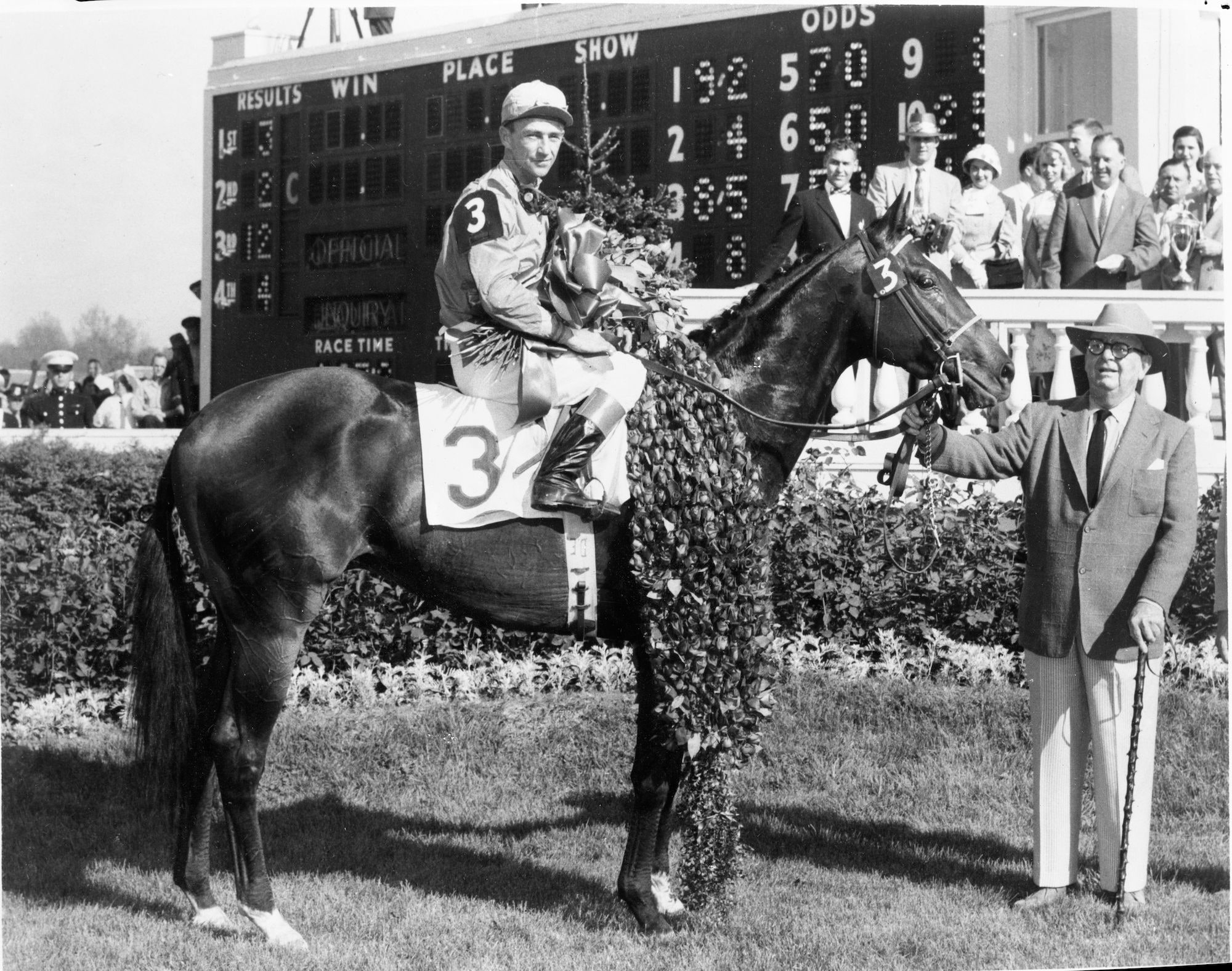
When Needles crossed the finish line under the Twin Spires, he became the first of six Florida breds to win the Kentucky Derby and the first of 26 victors to take the Florida Derby on their road to Louisville. But Needles’ win should not come as a surprise when we look at his pedigree. He is the last of SIX generations to win a classic, English or American, a streak that makes this lineage a rare example of what is possible when a sire meets a mare.
Red, White, and Blue Bloods
Needles put Florida on racing’s map with his 1956 Kentucky Derby victory, going from next-to-last on the backstretch to first at the finish line in a thrilling finish where he got the better of Calumet Farm’s Fabius. The Florida-bred had overcome a serious battle with pneumonia as a young foal to persevere as a racehorse, winning the Hopeful and Sapling Stakes at two and the Flamingo S. and the Florida Derby at three before arriving in Louisville. He entered the gate as the favorite and proved that the bettors’ faith in him was not misplaced – even if he did give a few people heartburn with his deep closing trip.
He came by that running style honestly: his sire, Ponder, in the same devil red and blue silks that Fabius sported, came from last to first over the 10 furlongs of the 1949 Kentucky Derby. Winless at two, Ponder went off at longer odds than one might assume for a horse trained by Ben Jones and owned by Calumet, 16-1, and with Steve Brooks in the saddle, he was sixth with a quarter of a mile to go and then third in the stretch run, with just Palestinian and Capot ahead of him. At the wire, he was three lengths to the good, surprising even his trainer with his performance. But really, no one should have been astonished because look who his sire and grandsire were.
In 1940, Lord Astor reached out to Claiborne’s Arthur Hancock II to offer three English mares: Sunbeat, Miss Erene III, and Penicuik II, who had a Hyperion colt by her side. Hancock took him up on his offer, and the three mares headed stateside, but not before Penicuik II was covered by Hyperion. When she arrived in Kentucky, Hancock sold her to Warren Wright of Calumet Farm, and on Feb. 5, 1941, she foaled a chestnut colt with a circle of white on his forehead and two white socks. Wright would name him Pensive.
Pensive was a decent two-year-old, winning twice, but really shone at three, beating older horses before heading to Louisville for the 70th Run for the Roses. Thirteenth of sixteen at the half-mile, jockey Conn McCreary had him on the outside until leaders Broadcloth and Stir Up went wide on the turn. McCreary then ducked Pensive toward the inside and moved up to third in the stretch, taking the lead inside the final furlongs to win by 4 1/2 lengths. He took that late running style to Pimlico, where he was fifth of seven early before taking the lead in the stretch.
Pensive passed that tendency to make the one run late on to Ponder and Needles, but the quality that
Roots in English Excellence
The three Derby winners can thank their English roots for their success at the 10 furlongs of the Run for the Roses. Starting with Pensive’s sire Hyperion, the three generations of winners in America continue a line started with Bayardo. In 1909, an unusually severe winter prevented many of the year’s classic contenders from having a complete season of preparation for the three races, including Bayardo, who fell short in both the Two Thousand Guineas and the Epsom Derby. By September’s St. Leger, the 14-furlong classic at Doncaster, though, Bayardo was in excellent form and won that test with ease.
At stud, Bayardo’s career was cut prematurely short by thrombosis at age 11, but not before he had sired two wartime Triple Crown winners in Gay Crusader in 1917 and Gainsborough in 1918. Though Gay Crusader does appear in the pedigree of the great Ribot, Bayardo’s excellence continued through Gainsborough. His dam was Epsom Oaks winner Rosedrop, so the bay colt came by his abilities honestly. The three classics were all run at Newmarket owing to World War I, but that did not change the fact that Gainsborough had the right stuff at a mile, at a mile and a half, and at a mile and three-quarters.
He passed on that right stuff to subsequent generations, including a smallish chestnut colt who stood only 15.1 hands, Hyperion. Because of his size, his owner, Lord Derby, did not nominate his late-developing colt for the Two Thousand Guineas, but he did run in the Derby in June and the St. Leger in September, winning both. As good a racehorse as he was, Hyperion was an even better sire. He was England's leading sire six times and produced multiple winners of the English classics. Louis B. Mayer even offered $1 million for the stallion but settled for his son Alibhai instead.
Penicuik II’s sale to Hancock and then Wright, with Pensive in utero, brought these bloodlines stateside and created another trio of classic generations. Though Needles was not able to duplicate himself and produce another Kentucky Derby winner, Hyperion still remains part of the bloodlines of American Thoroughbreds through Northern Dancer, one of the 20th century’s most dominant sires.