2026 Preakness: Top 10 storylines
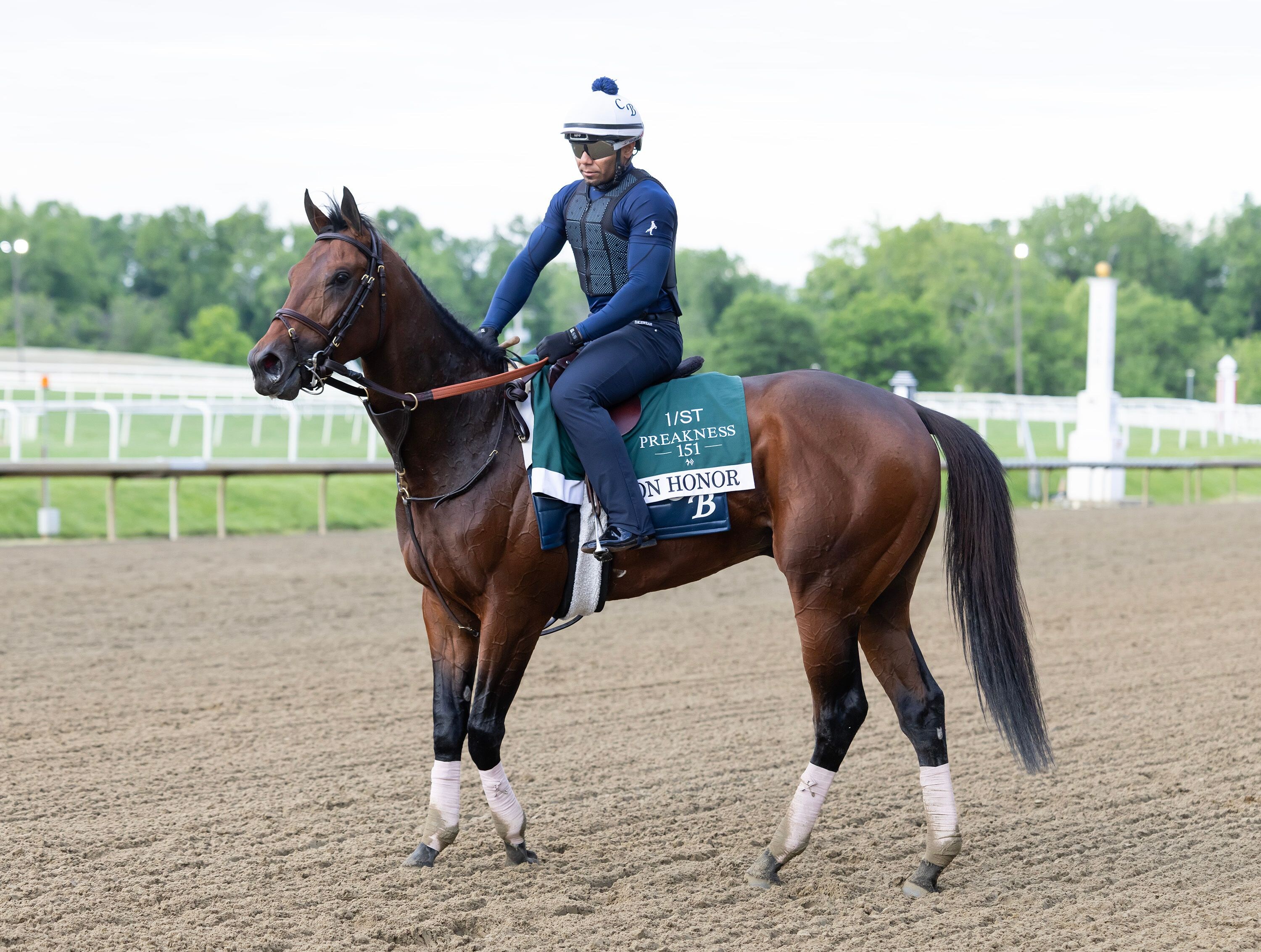
Iron Honor, the Preakness morning-line favorite, at Laurel Park (Photo by Equi-Photo)

Updated:
Saturday’s 151st running of the Preakness (G1) may be lacking the Kentucky Derby (G1) winner, but the middle jewel of the Triple Crown is not lacking in historic angles.
Laurel Park hosts as Pimlico is redeveloped
The initial storyline took root some time ago. With plans to redevelop the home of the Preakness, Pimlico, finally coming into play, Laurel Park is now playing the role of host as its sister track in Maryland.
This change of venue for the 2026 Preakness calls to mind the similar transfer of the Belmont Stakes Racing Festival to Saratoga during the redevelopment of Belmont Park, but there is a notable difference. While the switch upstate has led to the shortening of the Belmont (G1) from 1 1/2 miles to 1 1/4 miles during its Spa sojourn, the relocated Preakness remains at its traditional 1 3/16-mile distance.
Laurel has a wider track (95 feet) than Pimlico (70 feet), with a longer homestretch that features two finish lines. Yet a 1 3/16-mile race ends at the first finish line. As a result, the Preakness at Laurel will have a slightly shorter stretch run (1,089 feet) than it does at Pimlico (1,152 feet), according to the Maryland Jockey Club. On the other hand, closers aren’t necessarily at a disadvantage, especially given the abundance of early speed signed on at Laurel.
Of course, this is not the first time that the Preakness has needed a home away from home. The feature was held in New York for several years around the turn of the 20th century, at Morris Park (1890), and after a hiatus, at Gravesend (1894-1908).
Golden Tempo’s absence reignites discussion of Triple Crown schedule
It wasn’t a great surprise that Kentucky Derby upsetter Golden Tempo opted to skip the Preakness. Trainer Cherie DeVaux’s methodology is to prefer a longer turnaround time than two weeks, in keeping with the contemporary trends to space races out, and the colt’s connections figured to rely on her judgment. Co-owner/breeder Phipps Stable is a byword for the conservative approach, and Vinnie Viola’s St. Elias Stable is also involved in Iron Honor, who was always ticketed for the Preakness.
This marked the second straight year that the Derby hero swerved the middle jewel, after Sovereignty declined to wheel back in 2025. As a Godolphin homebred trained by Bill Mott, he likewise represents industry titans whose willingness to forego a Triple Crown bid sparked lively conversation.
Moreover, it’s not just the Derby winner passing on the Preakness. Very few combatants from the Run for the Roses are advancing to Laurel – three who actually ran, and four if you count Great White, a gate scratch at Churchill Downs. The most accomplished of the Derby trio, Incredibolt, was not even in the reckoning until a last-minute change of plan on entry day. Trainer Riley Mott cited the combination of how the Preakness field was shaping up and how well he was coming out of his Derby sixth to explain the U-turn.
The story was the same in 2024 and 2025, when only three competed in both the Derby and Preakness. In 2023, Derby winner Mage was the only one who bothered to turn up at Pimlico.
As more trainers find the two-week stretch between the Derby and Preakness unsuitable, the calls grow louder to increase the gap to three or four weeks. But that would push the Belmont deeper into the summer.
Is the inflation of the Triple Crown schedule really a solution? Even if it incentivizes more horses to run in the first two jewels, are they more likely to make it to the Belmont? Or might the attrition simply set in later? Developing three-year-olds must be far enough along in the spring even to make the Derby, and I don’t think it’s realistic to expect all the main players to maintain top form (and avoid setbacks) over an extended Triple Crown schedule.
Jose Ortiz seeks rare Derby/Preakness double with different horses
Golden Tempo’s regular rider, Jose Ortiz, has the chance to achieve a rare Derby/Preakness double in the same year – aboard different horses. Ortiz renews his old acquaintance with Chip Honcho, whom he rode to his maiden victory at Churchill Downs last November.
Calvin Borel is the most recent jockey to turn the unusual double. In 2009, he engineered a 50-1 Kentucky Derby shocker aboard Mine That Bird, but stuck with superstar filly Rachel Alexandra in the Preakness. Rachel Alexandra proved the wisdom of Borel’s decision when she beat Mine That Bird at Pimlico and went on to Horse of the Year honors. Ortiz fans might view it as an auspicious sign that Rachel Alexandra was trained by Hall of Famer Steve Asmussen, like Chip Honcho.
As revealed in the Preakness notes from the Maryland Jockey Club, you have to go back to the late 19th century to find the sole precedent for a Derby/Preakness double with different mounts. In 1898, Hall of Fame jockey Willie Simms steered Plaudit in the Derby and Sly Fox in the Preakness.
Another jockey milestone is theoretically possible for Hall of Famer John Velazquez. If he can galvanize longshot Corona de Oro to pull a massive upset, the 54-year-old would become the oldest jockey to win the Preakness. Mike Smith was 52 when he piloted Triple Crown champion Justify (2018).
Chip Honcho represents Golden Tempo’s Fair Grounds form
Aside from the jockeys’ trivia angle, Chip Honcho’s main talking point is that he comes out of the Fair Grounds series of preps that also launched Golden Tempo. The hardy colt ran in all four of them, with an alternating pattern of fortunes that could presage a return to form here.
Chip Honcho used his tactical speed to best effect when winning the Gun Runner S. and finishing second to Paladin in the Risen Star (G2), where Golden Tempo was a non-threatening third. Chip Honcho was less effective in the other two Fair Grounds features, fading to fourth in the Lecomte (G3) and fifth in the Louisiana Derby (G2). Golden Tempo beat him in those two, but Chip Honcho’s Risen Star effort illustrates that he can hold his own in top company with the right set-up.
Asmussen believes that Laurel, with an attendance cap of 4,800 for Preakness Day, will provide a more relaxed atmosphere to help the colt. The presence of other speed might complicate his task, but as long as he’s in a comfortable rhythm in a handy position, he can go a long way. It would be neat if a grandson of Asmussen’s first Preakness winner, Curlin (2007), could give him a third trophy.
Iron Honor fits the Chad Brown profile
Trainer Chad Brown is also seeking a third Preakness victory with Iron Honor, whose profile is generally reminiscent of his past winners Cloud Computing (2017) and Early Voting (2022). All were graduates of the Aqueduct winter preps who targeted the Preakness, rather than getting caught up in Derby fever.
Still, there are variations among them. Early Voting had the strongest resume of the trio, romping in the Withers (G3) before sustaining his first loss by a neck in the Wood Memorial (G2). Cloud Computing settled for second in the Gotham (G3) and a distant third in the Wood.
Iron Honor won the Gotham, but otherwise, he’s a bit nearer to Cloud Computing than Early Voting. Like Cloud Computing, Iron Honor debuted in a six-furlong maiden. Iron Honor was also well beaten in the Wood, winding up seventh after early trouble, but his 4 1/4-length margin of defeat was no disgrace.
The most striking difference is that Iron Honor makes an equipment change for the Preakness. Neither Early Voting nor Cloud Computing wore blinkers in their career, but Iron Honor takes them off here. Brown has a 24% strike rate with the “blinkers-off” move, according to Brisnet.com stats.
Local hero Taj Mahal could make more history for Brittany Russell
As the Federico Tesio S. winner, Taj Mahal carries the mantle of the local hope. But that perennial sentimental angle takes on an entirely different dimension this year, thanks to trainer Brittany Russell. Already a history-maker as the first woman to rank as Maryland’s champion trainer in 2023 – a title she’s maintained through the ensuing years – Russell could become the first to train a Preakness winner.
The timing, right on top of DeVaux’s historic breakthrough as a female trainer winning the Derby, has intensified the media attention. The closest a woman came to Preakness glory was 2002, when Nancy Alberts sent out homebred Magic Weisner to finish second, just three-quarters of a length shy of War Emblem.
To enhance the plot that sounds positively cinematic, Taj Mahal is ridden by the trainer’s husband, Sheldon Russell. If the speedy Taj Mahal can run himself into the winner’s circle, he would complete the set of Triple Crown races for women trainers. Jena Antonucci was the trailblazer with the 2023 Belmont champion Arcangelo.
Ocelli hopes to revive the ancient trend of maidens winning the Preakness
Third in the Kentucky Derby at 70-1, Ocelli outperformed his status as a maiden who drew in from the also-eligible list. Now he’ll try to become the first to break his maiden in the Preakness since Refund in 1888.
Interestingly, Refund was the last gasp of a trend for maidens in the race’s early years. Thanks to laborious research by the late historian Allan Carter, as preserved in the Preakness media guide, we know that five other maidens prevailed in the first decade: Survivor (1873 inaugural), Culpepper (1874), Shirley (1876), Cloverbrook (1877), and Saunterer (1881).
One more chance for the 2025 Champagne form?
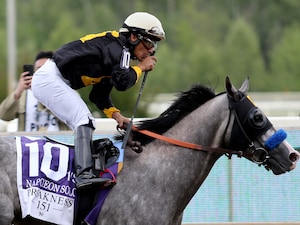
When Napoleon Solo put on an exhibition in last fall’s Champagne (G1), romping in 1:34.57 for the one-turn mile, he fueled hopes of great potential. Talkin’s closing second, for a colt of his profile, likewise glimmered with promise for the future.
Unfortunately, the Derby trail didn’t pan out for them. Both endured challenges along the way, putting them behind the curve, but their latest losses had the whiff of turning the corner.
Napoleon Solo, who didn’t break cleanly when fifth in the Fountain of Youth (G2), was reportedly dealing with a hoof bruise before his better fifth in the Wood. Talkin got sick and took time to recover his health and strength, and his third in the Blue Grass (G1) indicates that it’s onwards and upwards from here.
Good Magic in hot pursuit of sire Curlin
Pedigree fans have another reason to root for Talkin. As a son of champion Good Magic, who has sired Derby winner Mage (2023) and Belmont-winning brother Dornoch (2024), Talkin could complete a Triple Crown sweep for his young sire.
Good Magic is himself by Hall of Famer Curlin, who just rounded out his U.S. classic collection with Golden Tempo in the Derby. Curlin previously racked up the Belmont courtesy of his first-crop son Palace Malice (2013) and a pair of Preakness trophies via Exaggerator (2016) and Journalism (2025).
Sons of New Mexico, Oklahoma starlets advertise regional programs
Although The Hell We Did and Crupper are Kentucky-breds by high-profile stallions (Authentic and Candy Ride, respectively), both are homebreds out of mares reared in less fashionable state-bred programs.
The Hell We Did is a son of the Peacock family’s New Mexico-bred star Rose’s Desert, a multiple stakes winner in her home state and now a blue hen. Rose’s Desert has produced five stakes winners so far, including 2024 Saudi Cup (G1) upsetter Senor Buscador. Todd Fincher has trained Rose’s Desert and her progeny, making for an all-around family atmosphere enveloping The Hell We Did’s Preakness bid.
Crupper brings the same kind of homespun feel as the son of Robert Zoellner’s Oklahoma-bred standout She’s All In. Once again, the same trainer developed mother and son – Donnie Von Hemel, himself a member of a celebrated racing family.