Royal Ascot and U.S. bettors: Five key factors driving interest
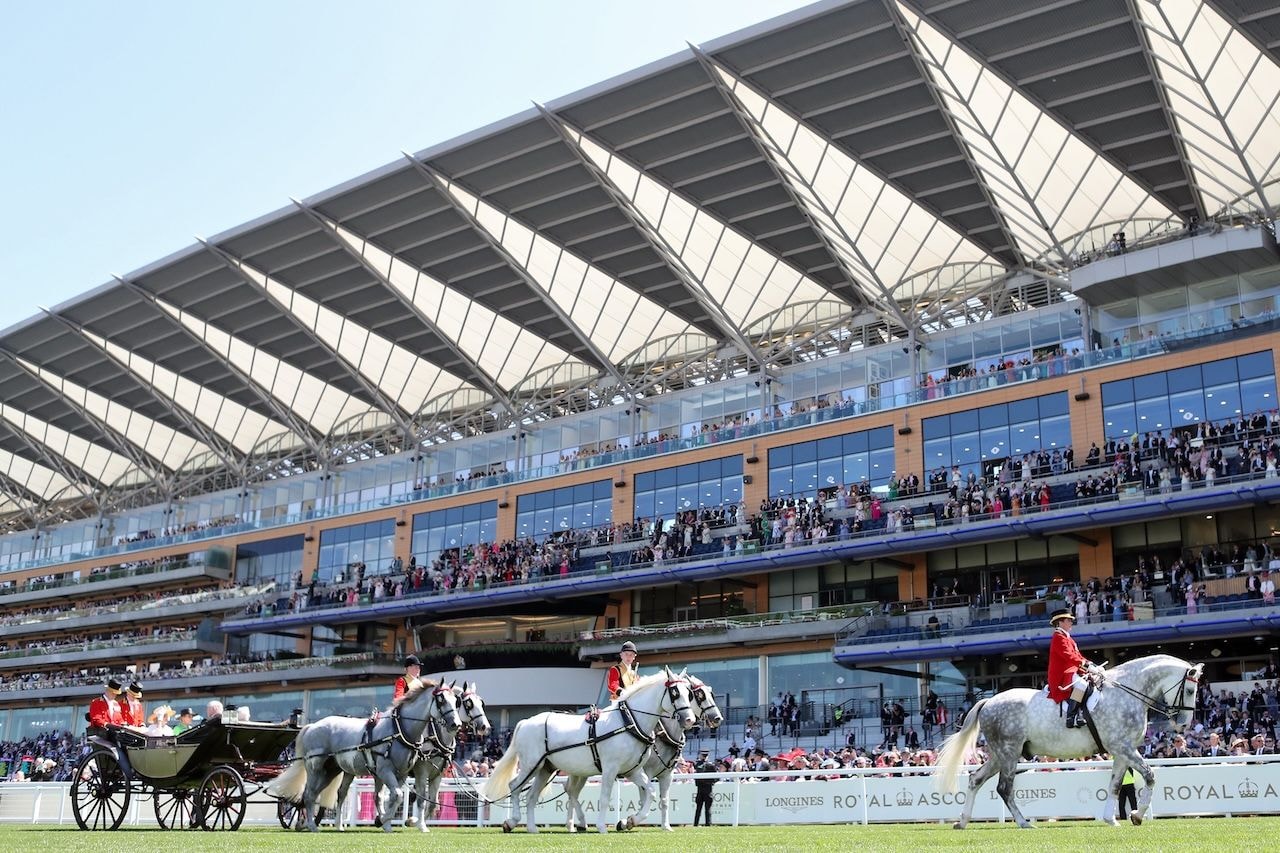
Royal Ascot scenic from day two of racing. (Photo by Horsephotos.com)

Updated:
Royal Ascot captures the imagination because of its unique blend of monarchical pageantry, social prestige, high fashion, and the spectacle of top-level Thoroughbred racing.
The premier British festival, slated for June 16-20, 2026, has taken on even greater importance for U.S. racing fans in recent years. Five key factors have aligned to drive interest across the pond:
- American success
- NBC Sports coverage
- Breeders’ Cup Challenge races
- World Pool betting
- Social media
Let’s explore how these developments have made the Royal meeting more accessible and more bettable for U.S. fans.
American success
Although Royal Ascot has always appealed to internationally minded racing enthusiasts, it was a niche interest for those familiar with the main players. Once American-trained horses began competing and winning, the festival was no longer foreign to the wider U.S. racing public.
Wesley Ward was the trainer who proved that U.S. shippers could beat the British on their home turf. In his first foray to Royal Ascot in the summer of 2009, Ward sent out two winners, both two-year-olds. Strike the Tiger struck a blow for history in the Windsor Castle S., and Jealous Again romped by five lengths in the Queen Mary (G2).
Ward subsequently added 10 more wins, bringing his total to 12 so far. Overall, Team USA has collected 14 wins at the Royal meeting, nine of them in the juvenile races.
In 2023, Gulfstream Park created a pathway for aspiring two-year-olds in the Royal Palm Juvenile and the Royal Palm Juvenile Fillies. The winner of each race receives a travel stipend and an automatic entry to a Royal Ascot juvenile event. Gulfstream’s program has already paved the way for a Royal Ascot winner, Crimson Advocate, who captured the 2023 Queen Mary for George Weaver.
But the greatest American winner is Hall of Fame racemare Tepin. Trained by Mark Casse, himself a Hall of Famer in both the U.S. and Canada, Tepin defeated males in the 2016 Queen Anne (G1) over a mile.
NBC Sports coverage
The next decisive step came in 2017, when NBC Sports Group began offering coverage through its various platforms. The meeting thereby reached a far wider U.S. audience, beyond hard-core fans tuning in on dedicated racing channels. Now it was accessible to general sports fans and casual viewers drawn by the royal-watching and lifestyle elements.
The press release announcing the media rights deal mentioned angles of interest to Americans. The Ward-trained Undrafted, winner of the 2015 Queen Elizabeth II Jubilee (G1), was noted for his sports crossover appeal. His co-owner, Wes Welker, was an undrafted NFL player who inspired the horse’s name.
While the entire five-day meeting is available on NBC’s streaming platform, Peacock, the Saturday finale is also on NBC proper. As a sign of the power of the network broadcast, Royal Ascot tweaked its traditional line-up to accommodate the Saturday schedule.
The Norfolk (G2) was moved from its Thursday spot to Saturday “in order to maximise television exposure for that race in the USA,” as the Royal Ascot media guide explained. There’s a desire to increase exposure because the Norfolk is a “Win and You’re In” for the Breeders’ Cup Juvenile Turf Sprint (G1).
Breeders’ Cup Challenge races
Although the Breeders’ Cup has historically attracted European stars who also competed at Royal Ascot, the two festivals strengthened their link formally in 2018. Four marquee races at the Royal meeting became part of the Breeders’ Cup Challenge program, serving as “Win and You’re In” events for Breeders’ Cup races in the corresponding divisions.
Three of those original four remain on the schedule – the Norfolk; Tuesday’s Queen Anne, a “Win and You’re In” for the Breeders’ Cup Mile (G1); and Wednesday’s Prince of Wales’s (G1), connected to the Breeders’ Cup Turf (G1).
The Breeders’ Cup Turf Sprint (G1) was initially tied to the six-furlong Jubilee on Saturday. In 2022, the “Win and You’re In” perk was transferred to a more suitable five-furlong dash on opening day, the race now known as the King Charles III (G1).
As a result of that change, the final day was left without a Challenge event. Hence, the Norfolk was repositioned this year to restore a “Win and You’re In” to the Saturday card.
If the Challenge program provides incentives for international connections to ship to the Breeders’ Cup, it simultaneously helps to raise awareness for U.S. fans. Royal Ascot thus becomes not only an interesting event to watch in June, but a potential pointer to specific races during the championships stateside in the fall.
World Pool betting
Awareness, accessibility, and American participants generate interest, but U.S. bettors gained additional material reasons to wager on the Royal meeting thanks to the inauguration of the World Pool in 2019.
Operated by the Hong Kong Jockey Club, the World Pool commingles bets placed in participating jurisdictions on designated major racing events into a single pool. This global pari-mutuel pool dwarfs the size of geographically limited pools, offering greater stability in horses’ odds, more opportunities to find value in the market, and potentially bigger exotics payouts.
The World Pool handle on Royal Ascot in 2025 totaled about $200.58 million (according to the exchange rate used by BloodHorse.com), close to the meeting’s record handle of approximately $205 million set in 2022.
Social media
The social media revolution has amplified all these factors, making an impact on the racing world as in the rest of contemporary life.
Since the turn of the millennium, the Internet has made it possible for fans to follow international racing in real time. But these aficionados had to be self-starters who curated their own web experiences.
The phenomenon of social media over the past decade or so has expanded the reach of international racing. With sophisticated algorithms playing to users’ behavior, fans are now served up an endless stream of content from an eclectic variety of sources.
Beyond the photos, replays, and compelling stories, social media has created communities of shared interests worldwide. Racing fans around the globe are united in watching equine celebrities take the stage, celebrating their successes, arguing about their relative merits – all with an immediacy that was previously impossible.
While this dynamic transcends Royal Ascot, the festival feeds into it by featuring horses from the U.S., Japan, Australia, and Europe. The Royal meeting takes on another dimension, as an interactive, communal experience for fans spanning every time zone.