Does a Recent Prep Race Win Guarantee Kentucky Derby Success?
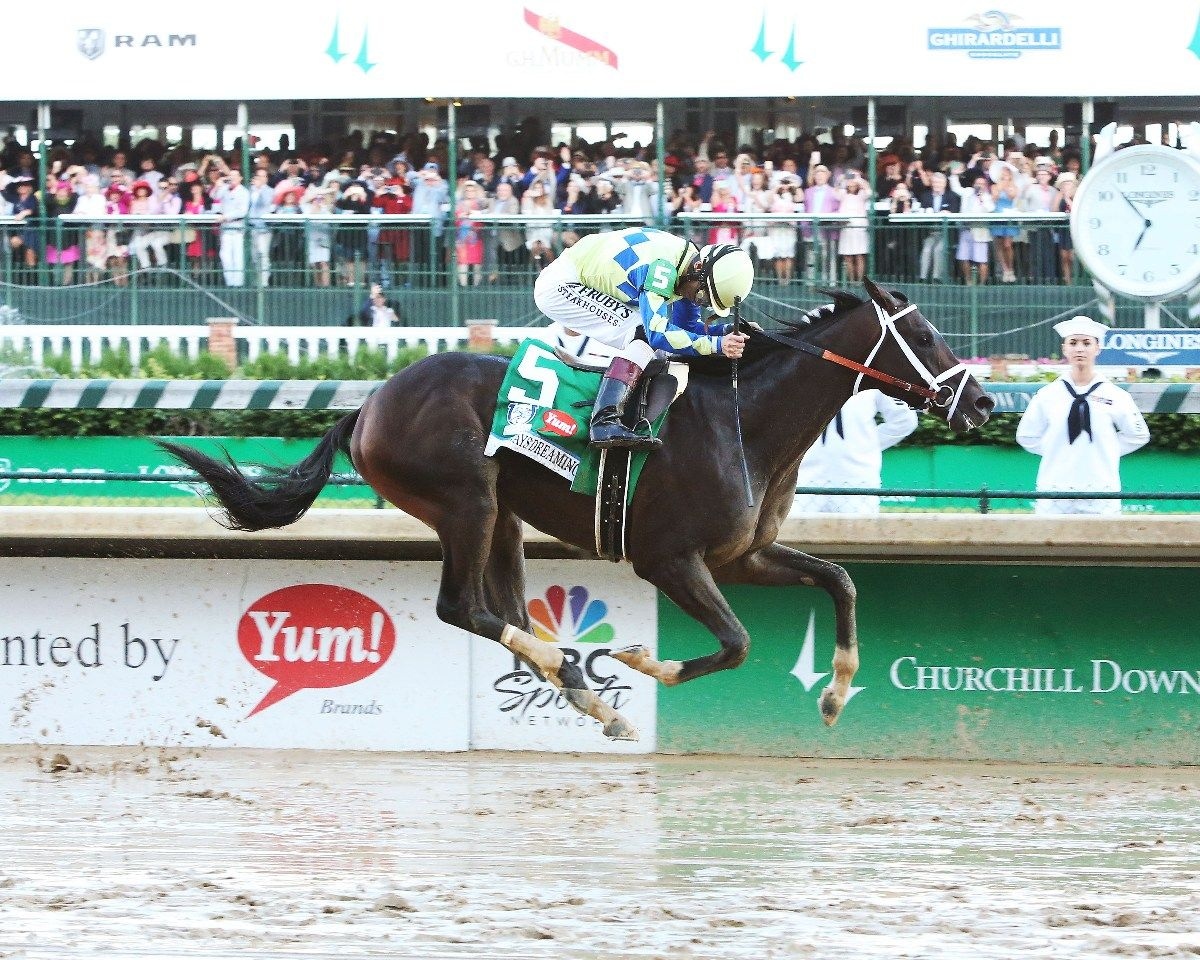
Always Dreaming winning the 2017 Kentucky Derby (Photo by Coady Photography)

Updated:
Do horses entering the Kentucky Derby (G1) off victories outperform those exiting defeats? We’re ready to provide a data-driven answer.
The most simplistic way to grab an answer is to count the number of last-out winners and last-out losers who have won the Kentucky Derby. In the years since the Road to the Kentucky Derby qualifying series of prep races debuted in advance of the 2013 Run for the Roses, seven Kentucky Derby winners exited a victory and six entered off a defeat. This suggests last-out winners have a slight, but not significant, advantage.
However, this considers only the performance of Kentucky Derby winners, not horses finishing second, third, fourth, etc., which bettors hoping to cash lucrative exotic wagers like the superfecta and Super High 5 must consider.
Also, this simplistic view does not account for the number of horses in each category. What if the slightly higher success rate of last-out winners stems from the fact that they outnumber last-out losers?
We’re going to dig deeper into the data to determine which category of horses performs best.
Research methodology
First off, we’re going to count the number of last-out winners and last-out losers who have started in the Kentucky Derby since 2013. This will provide context for the number of wins each category produces.
Then, we’ll calculate the average finishing position of last-out winners and last-out losers, to see how each category performs across the full order of finish in the Kentucky Derby.
Finally, we’ll consider whether track conditions—if the track is fast, sloppy, etc.—impact the relative performances of the two types of horses.
Note: For the purpose of this study, we are counting 2018 Kentucky Derby winner Justify as a last-out winner. Bettors handicapping the 2018 Kentucky Derby viewed Justify as a last-out winner based on his triumph in the Santa Anita Derby (G1), so even though he was disqualified from that win in 2024, we’re using the data that would have been relevant to handicappers in 2018.
Data analysis
Win percentages of last-out winners vs. last-out losers
In every Kentucky Derby since 2013, last-out losers have outnumbered last-out winners. The largest gap was in 2020, when the two last-out winners faced 13 last-out losers.
| Year | # of last-out winners | # of last-out losers |
| 2025 | 8 | 11 |
| 2024 | 9 | 11 |
| 2023 | 6 | 12 |
| 2022 | 9 | 11 |
| 2021 | 8 | 11 |
| 2020 | 2 | 13 |
| 2019 | 7 | 12 |
| 2018 | 8 | 12 |
| 2017 | 9 | 11 |
| 2016 | 9 | 11 |
| 2015 | 7 | 11 |
| 2014 | 7 | 12 |
| 2013 | 8 | 11 |
| Total | 97 | 149 |
All told, the last 13 editions of the Kentucky Derby have featured 97 last-out winners and 149 last-out losers. This means last-out winners have compiled a 7-for-97 (7.2% win rate) record, while last-out losers have gone 6-for-149 (4.0%).
Viewed through this lens, last-out winners are 1.8 times more likely to win the Kentucky Derby than last-out losers.
Average finishing positions of last-out winners vs. last-out losers
Across the last 13 runnings of the Kentucky Derby, last-out winners have recorded higher average finishing positions than last-out losers on 11 occasions. The peak came in 2020, when a pair of last-out winners finished first and second while the rest of the horses (all last-out losers) finished third through 15th, resulting in average finishing positions of 1.5 and 9.0.
| Year | Last-out winners | Last-out losers |
| 2025 | 9.5 | 10.4 |
| 2024 | 7.1 | 12.6 |
| 2023 | 7 | 10.8 |
| 2022 | 9.4 | 11.4 |
| 2021 | 9.3 | 10.5 |
| 2020 | 1.5 | 9 |
| 2019 | 10.9 | 9.5 |
| 2018 | 9.5 | 11.2 |
| 2017 | 11.4 | 9.7 |
| 2016 | 8 | 12.5 |
| 2015 | 4.9 | 12.5 |
| 2014 | 7.4 | 11.5 |
| 2013 | 9.3 | 10.5 |
| Average | 8.1 | 11 |
If you average all the averages since 2013, last-out winners have compiled an average finishing position of approximately eighth place. This is three spots better than the average finishing position of last-out losers, which rounds to 11th place.
Notably, the two years in which last-out losers recorded a higher average finishing position than last-out winners were 2017 and 2019—two years in which the Derby was contested over a wet track. This leads to another fascinating data discovery:
Performance of last-out winners vs. last-out losers: fast tracks vs. wet tracks
Five times in the last 13 years—in 2013, 2017, 2018, 2019, and 2025—the Kentucky Derby has taken place over a wet track. Four were labeled sloppy, and one was labeled wet fast. The other eight Derbys since 2013 have been contested over fast tracks.
Over fast tracks, last-out winners have gone 4-for-57 (7.0%) while last-out losers have compiled a 4-for-92 (4.3%) tally, meaning last-out winners are about 1.6 times more likely to win.
Over wet tracks, last-out winners have gone 3-for-40 (7.5%) while last-out losers have gone 2-for-57 (3.5%), meaning last-out winners are roughly 2.1 times more likely to win.
In terms of average finishing positions, last-out winners have outperformed last-out losers in 100% of Derbys contested over fast tracks. On average, they finished about 4.5 spots higher.
| Year | Last-out winners | Last-out losers |
| 2024 | 7.1 | 12.6 |
| 2023 | 7 | 10.8 |
| 2022 | 9.4 | 11.4 |
| 2021 | 9.3 | 10.5 |
| 2020 | 1.5 | 9 |
| 2016 | 8 | 12.5 |
| 2015 | 4.9 | 12.5 |
| 2014 | 7.4 | 11.5 |
| Average | 6.8 | 11.4 |
This advantage shrinks dramatically over wet tracks. Last-out winners have recorded a higher average finishing position than last-out losers in only three out of five wet-track Derbys (60%), and their average advantage is only 0.2 spots—basically a tie.
| Year | Last-out winners | Last-out losers |
| 2025 | 9.5 | 10.4 |
| 2019 | 10.9 | 9.5 |
| 2018 | 9.5 | 11.2 |
| 2017 | 11.4 | 9.7 |
| 2013 | 9.3 | 10.5 |
| Average | 10.1 | 10.3 |
Conclusions
While no prep schedule can guarantee success in the Kentucky Derby, on the whole, last-out winners outperform last-out losers in the Kentucky Derby.
Horses exiting a victory are 1.8 times more likely to win the Kentucky Derby than horses exiting a defeat.
This advantage extends down through the complete order of finish. Last-out winners regularly boast a higher average finishing position in the Kentucky Derby than last-out losers. On average, since 2013, last-out winners have finished nearly three spots higher than last-out losers.
However, track conditions can influence these numbers.
Regardless of track condition, last-out winners are more likely to win the Kentucky Derby than last-out losers.
But whereas last-out winners sharply outperform last-out losers in terms of average finishing position over fast tracks, the average finishing positions of last-out winners and last-out losers are nearly identical over wet tracks, suggesting wet footing can randomize the full order of finish in a meaningful way.