Stars, Stripes, and Silks: Great Racehorses with a Side of Patriotism
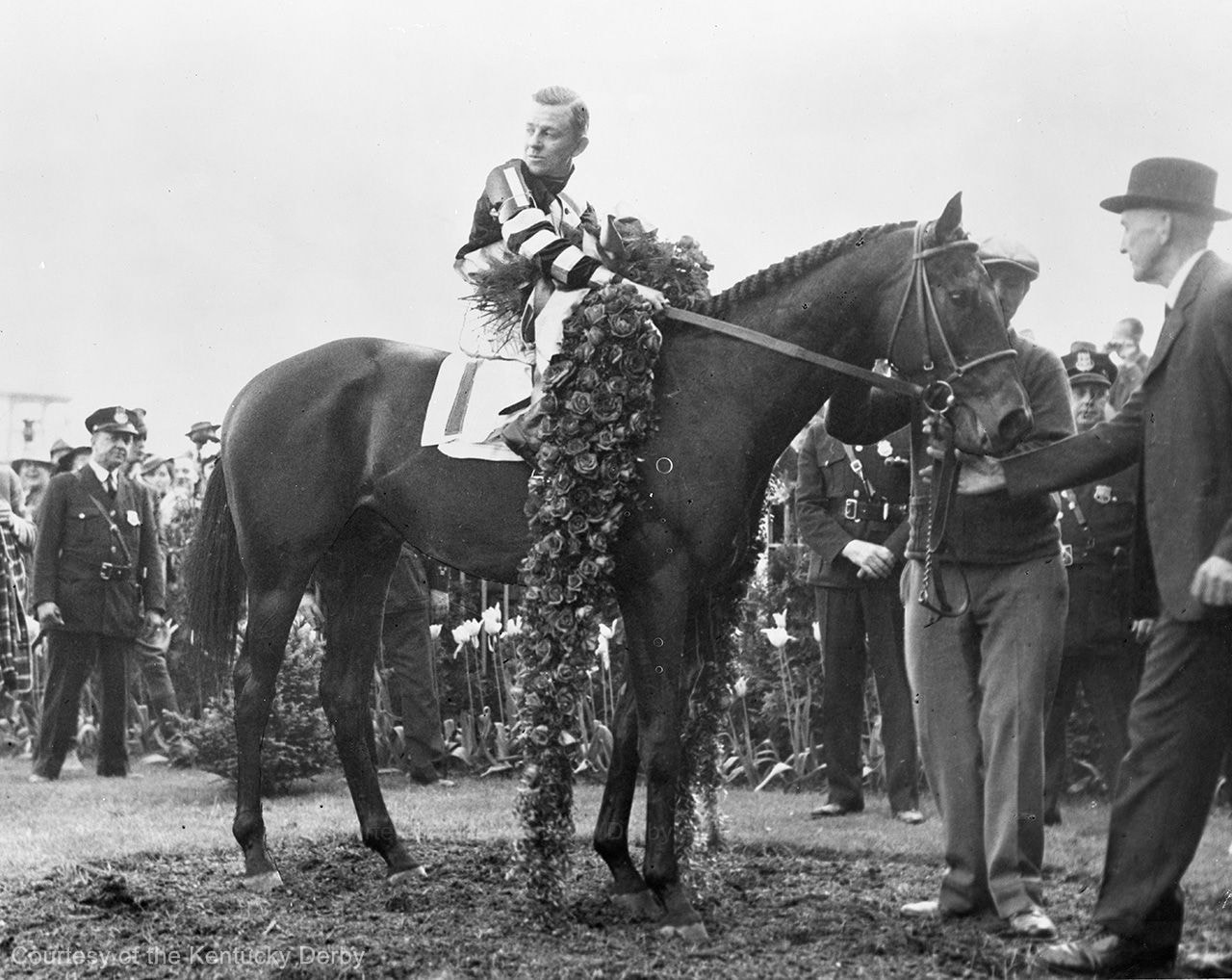
War Admiral wins the 1937 Kentucky Derby (Courtesy of the Kentucky Derby/Churchill Downs)

Updated:
There is something about the racetrack that has always stirred national pride. Perhaps it is the pageantry of the post parade, the roar of the crowd, or the sheer speed and heart of an animal running full tilt toward the wire — but for over a century, American horsemen have honored their country's history and heroes in the names they've given their fastest Thoroughbreds. From Man o’ War to Sergeant Reckless, these racehorses honor America with both their names and their greatness on the track and off.
Man o' War
He was originally named My Man o’ War by Eleanor Belmont, the wife of his breeder August Belmont II. The red chestnut was foaled in 1917, during the height of the First World War, when American troops joined their British, French, and Russian allies in the fighting. Because he was going to Europe to be a part of the war effort, Belmont sold that crop of yearlings, including the son of Fair Play and Mahubah, at Saratoga. He hammered down at $5,000 to Samuel Riddle, and the rest is history.
In the immediate aftermath of the war’s end, Man o’ War kicked off a golden age of sports with his nearly perfect record, his only blemish a second to a horse he passed two strides after the wire. When conjuring the ideal American Thoroughbred, inevitably Man o’ War comes to mind. He was so popular that thousands would come to visit him, and his November 1947 funeral was broadcast on the radio. He remains one of the most popular racehorses of all time.
War Admiral
This 15.2-hand brown colt stood a full hand shorter than his sire, but War Admiral’s speed and stamina echoed Man o’ War’s each time he stepped on the racetrack. He did Big Red one better in winning the Kentucky Derby in addition to the Preakness and Belmont Stakes, finishing out of the money only once in the 26 starts of his Hall of Fame career.
Of Man o’ War’s 381 foals, this son of the mare Brushup stands as his finest despite resembling his dam more than his famed father. In addition to his Triple Crown, War Admiral might be best remembered for his match race with another American superstar, Seabiscuit, a spectacle at Pimlico that attracted a crowd of more than 40,000 and a radio audience of more than 40 million. Though the Biscuit got the better of him, War Admiral stands among the best horses that this country produced in the 20th century.
American Flag
In 1921, Man o’ War’s first book included 15 handpicked mares, all belonging to his owner, Samuel Riddle. Among them was a daughter of French stakes winner Roi Herode, Lady Comfey, who never raced but was among the broodmares that British bloodstock expert William Allison selected for Riddle. The resulting foal was American Flag, a product of that first crop and one of three stakes winners that Lady Comfey would produce for Team Man o’ War.
Said to closely resemble his sire in looks, American Flag may not have been as accomplished as Big Red on the racetrack, but he did win the 1925 Belmont Stakes as well as the Withers and the Dwyer, New York features that were among the most important sophomore stakes of that era. At stud, the chestnut son of Man o’ War produced Nellie Flag, one of the first stakes winner of the devil red and blue of Calumet Farm. Warren Wright had purchased 1924 Preakness winner Nellie Morse from cartoonist Bud Fisher, who had paired her with American Flag when Man o’ War’s 1931 book was full. The result was the bay filly who would go on to produce champion Mar-Kell and Kentucky Oaks winner Nellie L.
Battleship
Another diminutive son of Man o’ War, Battleship echoed War Admiral in his on-track accomplishments. Bred by Walter Salmon’s Mereworth Farm, the chestnut colt was a fair racehorse on the flat, winning 10 of his 22 starts, before Marion duPont purchased Battleship for $12,000 to turn him into a steeplechaser. He won three of his four starts in 1933, including the Billy Barton Steeplechase at Pimlico, and then, in 1934, he captured four of six races, including the American Grand National at Belmont Park, before bowing a tendon, which knocked him out of competition for a year.
Sent to England to race, Battleship went to Reginald Hobbs’s yard and raced for three seasons there. He won six of 18 over those first couple of seasons and was even entered for the 1937 Grand National before Hobbs scratched him, objecting to the assigned weight impost. The following year, at age 11, duPont elected to try the stallion in that classic despite his 160-pound impost. With Hobbs’s son Bruce in the saddle, they were part of a field of 36 starters, with 13 ultimately finishing the four-mile, 30-jump course successfully. Battleship and Royal Danieli successfully navigated the last jump, the latter’s short advantage shrinking with each stride toward the finish line. The son of Man o’ War just caught Royal Danieli at race’s end, the margin of victory variously reported as a nose, a head, or a neck. Regardless, Battleship brought the English prize to his American home at duPont’s Montpelier estate, the former homestead of none other than James and Dolley Madison, the fourth President and First Lady of the United States.
Bald Eagle
Given his family’s connection to the United States, naming a horse Bald Eagle should not be a surprise. Captain Harry Guggenheim’s Nasrullah colt carried his colors in both England and America and earned his famed owner a championship as well.
As part of the wealthy mining family, Guggenheim got his first taste of racing as a child growing up near Sheepshead Bay Race Track and then continued his passion for the sport while studying in England. He worked for his family’s philanthropic interests between serving in World Wars I and II, and then expanded into breeding and owning racehorses in his 40s.
One of the mares he campaigned was Siama, who won a handful of stakes for Guggenheim’s Cane Hoy Stable, taking the Jasmine, Princess Doreen, and Acorn Stakes, plus the Monmouth Oaks at three. As a broodmare, she produced nine foals for Guggenheim, including a bay colt with a white star, Bald Eagle. He went to England to race as part of Cane Hoy’s European contingent with famed trainer Cecil Boyd-Rochfort preparing him for the English classics. At two, the Nasrullah colt won the Duke of Edinburgh Stakes at Ascot, and then the Craven and Dante Stakes at three, but fell short in the Two Thousand Guineas and Derby at Epsom.
Guggenheim brought Bald Eagle back to the United States to race at four and five, where he won consecutive editions of the Washington D.C. International on turf and the Suburban, Metropolitan, and Widener Handicaps on dirt. His versatility at distances a mile and longer made him a handicap division star and earned him the title of Champion Handicap Male for 1960. He retired to Spendthrift Farm and sired 12 stakes winners, including Too Bald, who won the Barbara Fritchie and the Bed o’ Roses and then, as a broodmare, produced Exceller, Capote, and Baldski.
Paul Jones
Named for the famed American naval commander John Paul Jones, the 1920 Kentucky Derby winner benefited from the absence of another horse on this list, Man o’ War. A gelded son of Sea King, he was the third of five Derby winners bred by John E. Madden’s Hamburg Place, after Old Rosebud in 1914 and Sir Barton in 1919. A fair juvenile, Paul Jones set a track record at Havre de Grace in a one-mile allowance and won three stakes that season. At three, he was one of 17 horses in the ultra-competitive Derby field, which included Upset, the horse who defeated Man o’ War in the 1919 Sanford Memorial. Paul Jones staved off Upset’s bid at the wire, winning by a nose.
The gelding had a decent career overall, amassing a record of 14-12-13 in 65 starts. Gifted by owner Ral Parr to the daughter of trainer William Garth, he went on to an informal steeplechasing career after his racing days were over and then served as her hunter mount before his early passing at age 13.
Sergeant Reckless
Before she was an American hero, she was a much-loved Korean racehorse. Her breeder and owner was a young South Korean trainer and jockey, Kim Huk Moon (a pseudonym), who received her dam, Flame, as a thank-you gift from American prisoners of war whom he helped while working at a Japanese camp. He bred Flame to another racehorse and got the filly he named Ah Chim Hai – Flame of the Morning – and raced her himself. But when war broke out between North and South Korea, racing in the country came to a halt, and Kim struggled to feed not only his family and himself but also the filly he loved so much.
Three Marines were looking for an agile and fast horse they could train to haul weapons and ammunition through the fiery chaos of war when they happened upon the racetrack where Kim had his beloved filly stabled. When Lieutenant Eric Pedersen met Flame, he knew they had the horse they needed. They bought her from an emotional Kim for $250, and the rest is history.
The 5th Marine Regiment’s Recoilless Rifle Platoon trained the filly to carry ammunition, and the filly, whom they nicknamed Reckless, quickly became known for her intelligence and ability to navigate dangerous terrain, often alone and under fire. She is most famous for her performance during the Battle of Outpost Vegas in March 1953, when she made 51 solo trips in a single day, hauling nearly 9,000 pounds of ammunition up steep, exposed hillsides while being wounded twice, all while also helping evacuate wounded Marines on the return trips. For her valor under fire, she was formally promoted to the rank of sergeant, received two Purple Hearts along with numerous other military honors, and was even allowed to live among the troops. She retired to Camp Pendleton in California, where she lived out her life with full military honors until she died in 1968, and is today remembered as one of the most celebrated animals in U.S. military history.
ADVERTISEMENT